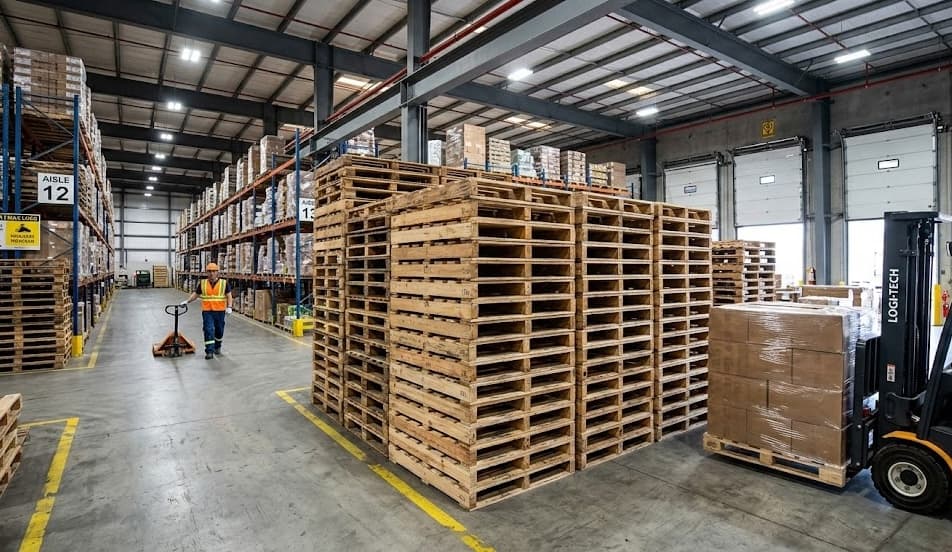
Pallets Built for Your Industry
Every industry has unique pallet requirements. We have the experience and inventory to meet them all - from food-safe plastic to heavy-duty block pallets.
Industries served
Pallets in US circulation
Of physical goods touch a pallet
New pallets built per year in US
Industries We Serve
Click on any industry to learn about our tailored pallet solutions, compliance capabilities, and pricing for your specific sector.
Food & Beverage
FDA-compliant, heat-treated, and hygienic pallets for food-safe supply chains. HACCP-compatible wood and plastic options.
- FDA / FSMA compliance
- Heat-treated & stamped
- Plastic pallet options
Manufacturing
Heavy-duty block pallets and custom sizes for automotive, machinery, and industrial production lines.
- 4,800+ lb capacity
- Custom dimensions
- High-volume repair programs
Retail & E-Commerce
Cost-effective used and reconditioned pallets for distribution centers, fulfillment warehouses, and retail store deliveries.
- Grade A reconditioned
- High-volume pricing
- Consistent supply
Pharmaceutical
Clean, contamination-free pallets for pharma logistics. Plastic and heat-treated wood options that meet GMP requirements.
- GMP-compliant
- Contamination-free
- Full traceability
Contact us for industry-specific info
Agriculture
Durable pallets for produce, nursery products, and agricultural equipment. Heat-treated for USDA and export compliance.
- ISPM 15 certified
- Field-durable construction
- Seasonal volume flexibility
Contact us for industry-specific info
Automotive
Block pallets and engineered crating for OEM parts, engines, and components. Built to withstand heavy, concentrated loads.
- Block pallet specialists
- Engine cradle pallets
- JIT delivery available
Contact us for industry-specific info
Construction
Sturdy pallets for building materials, tile, concrete products, and heavy equipment components.
- High-weight rated
- Oversized available
- Jobsite delivery
Contact us for industry-specific info
Government & Military
ISPM 15 certified wood packaging for defense logistics, base operations, and government procurement contracts.
- ISPM 15 / MIL-STD
- Full documentation
- Contract pricing available
Contact us for industry-specific info
Why Industry-Specific Pallets Matter
A pallet that works perfectly in a dry goods warehouse can fail spectacularly in a cold storage facility. Food-grade environments demand different materials than construction sites. Export shipments require certifications that domestic loads do not.
Choosing the wrong pallet grade, material, or size costs money in product damage, compliance fines, and operational inefficiency. We help you get it right the first time by matching the pallet specification to your exact application.
Our Cross-Industry Capabilities
- Heat-treated (ISPM 15) pallets for export-dependent industries
- FDA-grade plastic pallets for food and pharmaceutical sectors
- Heavy-duty block pallets rated to 4,800+ lbs for manufacturing
- Custom sizes from 24x24 to 60x60 for specialized applications
- High-volume recycling and buyback programs for large operations
- Same-day and next-day delivery across San Diego County
Not Sure Which Pallet Is Right for Your Industry?
Our team has worked with every industry on this page. Tell us what you ship and how you ship it, and we will recommend the right pallet spec.
Talk to a SpecialistIndustry-by-Industry Pallet Requirements
Every sector has unique regulatory, structural, and logistical demands for pallets. Understanding these differences is the key to choosing the right pallet specification, avoiding compliance violations, and controlling costs across your supply chain.
Food & Beverage
The most heavily regulated pallet environment in the United States. The FDA's Food Safety Modernization Act (FSMA) holds every link in the food supply chain accountable for contamination prevention — including packaging materials like pallets. Food and beverage operations must use pallets that are free of chemical treatments (no methyl bromide), biological contamination (heat-treated to ISPM 15 core temperature of 56 C for 30 minutes), and physical hazards (no splinters, protruding nails, or sawdust). HACCP plans in food facilities must include pallet sourcing as a Critical Control Point.
Key Compliance Requirements
- FDA / FSMA compliant materials
- HACCP-compatible — documented sourcing
- Heat-treated (HT) to ISPM 15 standard
- SQF and BRC audit-ready documentation
- No chemical treatments — HT only
- Plastic options for wet/cold environments
Recommended Pallet Types
New heat-treated wood (dry goods, export), Grade A reconditioned (warehouse distribution), HDPE plastic (cold chain, wet processing), presswood (single-use export)
Pharmaceutical & Medical
Pharmaceutical logistics demand the highest level of cleanliness and traceability. Good Manufacturing Practice (GMP) regulations under 21 CFR Parts 210 and 211 require that all materials entering a pharmaceutical production environment — including pallets — be free of contaminants that could affect drug product quality. The Drug Supply Chain Security Act (DSCSA) adds requirements for serialization and traceability that extend to packaging materials. Pharmaceutical companies increasingly require plastic or cleanroom-compatible pallets to eliminate particulate contamination risks associated with wood fiber.
Key Compliance Requirements
- GMP-compliant (21 CFR 210/211)
- Cleanroom-compatible plastic pallets
- Full lot traceability documentation
- Contamination-free — no particulates
- Temperature-controlled transport capable
- DSCSA supply chain documentation
Recommended Pallet Types
FDA-grade HDPE plastic (primary choice), new heat-treated wood (secondary storage), stainless steel pallets (cleanroom environments)
Automotive & Parts Manufacturing
Automotive supply chains operate on just-in-time (JIT) delivery schedules where a single pallet failure can halt an assembly line costing thousands of dollars per minute. Automotive pallets must handle concentrated point loads from engine blocks, transmissions, stamped body panels, and heavy castings. The industry standard is the nine-block pallet with four-way forklift entry, rated for static loads of 4,800 lbs or more. Tier 1 and Tier 2 suppliers in the San Diego–Tijuana manufacturing corridor have specific pallet specifications mandated by OEMs like Toyota, GM, and Ford.
Key Compliance Requirements
- Block pallets rated 4,800+ lbs static
- Four-way forklift entry mandatory
- JIT delivery within 4-hour windows
- ISPM 15 for cross-border Tijuana shipments
- Specific OEM pallet specifications
- Automated conveyor compatible
Recommended Pallet Types
Heavy-duty block pallets (primary), custom engine cradle pallets, reinforced stringer pallets (lighter components), plastic rackable pallets (clean assembly environments)
Agriculture & Produce
Agricultural pallets face unique environmental challenges: field dust, moisture, temperature extremes, and exposure to organic matter. Produce pallets must comply with USDA phytosanitary requirements and ISPM 15 for international export. The California Department of Food and Agriculture (CDFA) has additional requirements for pallets used in produce shipments to prevent the spread of invasive pest species. Seasonal demand in agriculture means pallet volumes can swing 300-400% between harvest and off-season, requiring a supplier with flexible inventory capacity.
Key Compliance Requirements
- ISPM 15 heat treatment for export
- USDA phytosanitary compliance
- CDFA pest-prevention standards
- Moisture-resistant construction
- Seasonal volume flexibility (300-400% swings)
- Field-durable — tolerates outdoor exposure
Recommended Pallet Types
Heat-treated stringer pallets (domestic produce), ISPM 15 certified block pallets (export), plastic pallets (wash-down produce packing), presswood (one-way export to Asia/EU)
Third-Party Logistics (3PL)
3PL warehouses are multi-tenant environments where pallets from dozens of different clients commingle in the same facility. This creates unique challenges: inconsistent pallet sizes disrupt racking systems, poor-quality pallets damage automated conveyors, and non-standard pallets create safety hazards for forklift operators. Leading 3PLs standardize on GMA 48x40 pallets and grade specifications to maintain operational efficiency. Pallet pooling programs and managed pallet services are increasingly popular in the 3PL sector to reduce the total cost of pallet management.
Key Compliance Requirements
- Standardized GMA 48x40 dimensions
- Consistent grading — no mixed quality
- High-volume weekly delivery programs
- Pallet buyback and recycling services
- Automated system compatible
- Racking-grade quality for warehouse storage
Recommended Pallet Types
Grade A reconditioned GMA (primary), Grade B reconditioned (shipping only), new GMA stringer pallets (premium clients), plastic pooling pallets (closed-loop systems)
E-Commerce & Fulfillment
E-commerce fulfillment centers process thousands of orders per day with aggressive cycle times that put extraordinary wear on pallets. The industry trend toward lightweight pallets (30-35 lbs vs. standard 50 lbs) saves significant freight costs when pallets are included in dimensional weight calculations. Amazon, Walmart Marketplace, and other major platforms have specific pallet requirements for inbound shipments to their fulfillment centers, including size, condition, and labeling standards. Non-compliant pallets are rejected at the dock, causing costly delays and chargebacks.
Key Compliance Requirements
- Lightweight construction (30-35 lbs)
- Amazon/Walmart inbound compliance
- Consistent dimensions for automation
- High turnover durability
- Cost-per-trip optimization
- Recyclable and sustainable materials
Recommended Pallet Types
Lightweight stringer pallets (parcel-weight loads), Grade B reconditioned (cost optimization), presswood pallets (single-use e-comm shipments), combo pallets (partial plastic/wood)
Construction & Building Materials
Construction pallets must handle some of the heaviest loads in any industry: concrete blocks, ceramic tile, roofing materials, steel beams, and bags of cement can push pallet weights well beyond 5,000 lbs. These pallets also face harsh treatment — jobsite delivery means forklifts operating on uneven terrain, outdoor storage in rain and sun, and rough handling by crews focused on speed rather than pallet preservation. Most construction pallets are single-use or limited-cycle, making cost per unit the primary decision factor.
Key Compliance Requirements
- 5,000+ lb load capacity
- Oversized dimensions (up to 60x60 and beyond)
- Outdoor/weather exposure tolerance
- Jobsite delivery to uneven terrain
- Single-use cost optimization
- Forklift-accessible on rough surfaces
Recommended Pallet Types
Heavy-duty stringer pallets (standard), custom oversized platforms (tile, roofing), hardwood block pallets (extreme weight), economy stringer pallets (single-use jobsite delivery)
Government & Military (DoD)
Department of Defense logistics follow MIL-STD-1660 for wood packaging material and require ISPM 15 heat treatment certification for all wood pallets used in military supply chains. The Defense Logistics Agency (DLA) maintains specific pallet specifications for different classes of supply. Government procurement contracts typically require full documentation including heat treatment certificates, material origin records, and compliance with the Berry Amendment for domestic sourcing. GSA Schedule pricing and SAM.gov registration may be required for direct government sales.
Key Compliance Requirements
- MIL-STD-1660 wood packaging compliance
- ISPM 15 heat treatment — IPPC stamped
- Berry Amendment domestic sourcing
- Full documentation and traceability
- DLA pallet specifications per supply class
- GSA Schedule / SAM.gov compatible
Recommended Pallet Types
ISPM 15 heat-treated stringer pallets (standard supply), block pallets (heavy equipment), custom crating and skids (weapons systems, sensitive equipment), hardwood pallets (ammunition and ordnance)
Compliance Requirements by Industry
Pallet compliance is not optional. Violations can result in shipment rejections, product recalls, import seizures, and fines ranging from $10,000 to $500,000 depending on the regulatory body. This matrix shows the key certifications and standards required for each industry.
| Regulation | Food | Pharma | Auto | Ag | 3PL | Retail | Const. | Gov/Mil |
|---|---|---|---|---|---|---|---|---|
| ISPM 15 (Heat Treatment) | Req'd | Opt. | Req'd* | Req'd | Opt. | Opt. | Opt. | Req'd |
| FDA / FSMA Compliance | Req'd | Req'd | — | Req'd* | — | — | — | — |
| GMP (Good Manufacturing) | Rec'd | Req'd | — | — | — | — | — | — |
| HACCP Compatible | Req'd | Rec'd | — | Rec'd | — | — | — | — |
| MIL-STD-1660 | — | — | — | — | — | — | — | Req'd |
| SQF / BRC Audit Ready | Rec'd | Rec'd | — | Rec'd | — | — | — | — |
| Berry Amendment (Domestic) | — | — | — | — | — | — | — | Req'd* |
| OSHA Pallet Safety Standards | Rec'd | Rec'd | Req'd | Rec'd | Req'd | Req'd | Req'd | Req'd |
| Load Testing Certification | Opt. | Rec'd | Req'd | Opt. | Rec'd | Opt. | Rec'd | Req'd |
| Traceability Documentation | Req'd | Req'd | Rec'd | Req'd* | Opt. | Opt. | — | Req'd |
Req'd = Required by regulation | Rec'd = Recommended best practice | Opt. = Optional but available | * = Required for export/cross-border only | — = Not applicable
Industry Case Studies
Real examples of how the right pallet specification solved problems, reduced costs, and improved operations for San Diego businesses across multiple industries.
Cold Chain Beverage Distributor
Challenge
A San Diego beverage distributor was experiencing 12% pallet failure rates in their -10 F freezer warehouse. Wood pallets were cracking after 3-4 freeze/thaw cycles, causing product drops and forklift safety incidents. Their SQF auditor flagged pallet debris as a contamination risk.
Solution
We transitioned their freezer operations to HDPE plastic pallets rated to -40 F, while keeping heat-treated wood for their ambient warehouse. The plastic pallets were more expensive upfront ($48 vs. $18) but lasted 100+ cycles vs. 4-5 cycles for wood in the freezer environment.
Results
- Pallet failure rate dropped from 12% to under 0.5%
- Annual pallet cost reduced by 34% despite higher unit price
- Zero contamination findings on next SQF audit
- Forklift safety incidents related to pallets eliminated
Tier 2 Automotive Supplier — Tijuana Corridor
Challenge
A Tier 2 automotive parts manufacturer shipping between Otay Mesa and Tijuana maquiladoras needed ISPM 15 certified block pallets on a JIT schedule. Their previous supplier delivered inconsistent quality that caused conveyor jams on the receiving end, and pallets were frequently rejected at the border for missing or illegible IPPC stamps.
Solution
We implemented a managed pallet program with dedicated inventory reserved for their account. Every pallet is block construction, heat-treated, and individually inspected for stamp legibility and dimensional consistency before delivery. We maintain a 48-hour buffer stock at our yard.
Results
- Zero border rejections in 14 months of service
- Conveyor jam incidents reduced by 89%
- JIT delivery compliance at 99.2%
- Per-pallet cost reduced 18% through repair and return program
Regional Grocery Chain — Distribution Center
Challenge
A 40-store grocery chain was receiving mixed-grade pallets from a national supplier. Inconsistent board spacing caused product to shift during transport, and splintered pallets were damaging produce packaging in their distribution center. Returns and damage claims were costing $15,000/month.
Solution
We established a Grade A reconditioned pallet program with strict grading criteria: no board gaps exceeding 3 inches, no protruding nails, sanded top decks, and load-tested to 4,000 lbs. Weekly scheduled deliveries of 600 pallets replaced their inconsistent bulk purchases.
Results
- Product damage claims dropped 72% in the first quarter
- Pallet consistency complaints from stores eliminated
- Per-pallet cost reduced 22% vs. their national supplier
- Delivery reliability improved from 78% to 99.5% on-time
Defense Contractor — Camp Pendleton Support
Challenge
A defense logistics contractor supporting Camp Pendleton needed MIL-STD-1660 compliant wood packaging for international equipment shipments. They required full documentation trails for every pallet batch, Berry Amendment compliance for domestic sourcing, and ISPM 15 certification with legible IPPC markings that would pass DLA inspection.
Solution
We developed a dedicated military-grade pallet program using domestically sourced Southern Yellow Pine, heat-treated at our facility with calibrated kiln records. Every batch includes certificates of treatment, wood species documentation, and compliance statements that map to MIL-STD-1660 Section 5 requirements.
Results
- 100% pass rate on DLA packaging inspections
- Documentation preparation time reduced from 4 hours to 30 minutes per shipment
- Berry Amendment compliance verified and documented
- Contract renewed for 3 additional years with expanded scope
Why Different Industries Need Different Pallets
A pallet is not a commodity — it is an engineered component of your supply chain. The wrong specification creates cascading failures from the loading dock to the end customer. Here is why one-size-fits-all does not work.
Load Distribution Varies by Product
A pallet carrying 2,000 lbs of evenly distributed boxed goods experiences fundamentally different stress than a pallet carrying a 2,000-lb engine block concentrated in the center. Point loads require block construction and thicker deck boards. Distributed loads can use standard stringer pallets. Using the wrong design leads to deck board cracking, stringer splitting, and catastrophic failure under load.
Regulatory Requirements Are Industry-Specific
Food and pharmaceutical industries must comply with FDA, FSMA, GMP, and HACCP standards that do not apply to construction or retail. Military shipments require MIL-STD-1660 compliance. Export shipments across all industries require ISPM 15 heat treatment. Using a non-compliant pallet does not just risk a fine — it can result in product seizure, recall, or border rejection that shuts down your entire supply chain.
Environmental Conditions Differ Dramatically
A pallet that performs well in a climate-controlled warehouse will fail in a -20 F freezer (wood becomes brittle), a wet processing plant (wood absorbs moisture and molds), or an outdoor construction site (UV degradation and weathering). Material selection — wood species, plastic grade, or composite construction — must match the environmental conditions the pallet will face throughout its lifecycle.
Handling Equipment Varies by Facility
Manufacturing floors with automated conveyor systems require pallets with tight dimensional tolerances — even 1/4 inch of variation can cause jams. Warehouse racking systems need pallets rated for beam deflection under racking loads. Jobsites use rough-terrain forklifts that demand extra structural reinforcement. The handling equipment in your facility determines which pallet construction will survive.
Cost Optimization Models Are Different
A 3PL cycling through 5,000 pallets per month optimizes on cost-per-trip. A pharmaceutical company optimizes on contamination risk per dollar. A construction company optimizes on cost-per-unit with single-use economics. A manufacturer with a closed-loop system optimizes on total lifecycle cost including repair. The right pallet for your industry is the one that optimizes the metric that matters most to your operation.
Supply Chain Velocity Demands Different Durability
E-commerce fulfillment centers may cycle a pallet through 3-4 touchpoints in a single day. Agricultural pallets may sit in a field for weeks. Military pallets may be stored for months before deployment. The number of handling events, loading cycles, and transit impacts your pallet will experience determines the minimum construction standard needed to complete its mission without failure.
Average Pallet Cost by Industry
Pallet costs vary significantly by industry due to different material requirements, compliance certifications, and structural specifications. These are average per-unit costs for the most commonly ordered pallet type in each sector.
Food & Bev
$12 – $48
Wood to plastic range
Pharmaceutical
$35 – $75
Plastic/cleanroom dominant
Automotive
$28 – $55
Heavy-duty block pallets
Agriculture
$8 – $22
HT stringer pallets
3PL / Logistics
$6 – $15
Reconditioned GMA
E-Commerce
$5 – $14
Lightweight/economy
Construction
$10 – $35
Heavy-duty stringer
Government/Mil
$15 – $40
MIL-STD compliant
Need a Pallet Specification for Your Industry?
We have supplied pallets to every industry listed on this page and can provide detailed specification recommendations based on your product type, weight, handling environment, and regulatory requirements. Our team includes specialists who understand the compliance landscape for food, pharmaceutical, military, and export logistics. Contact us for a free specification review.
Frequently Asked Questions
What industries does San Diego Pallet Co. serve?
We serve food and beverage, manufacturing, retail, e-commerce fulfillment, third-party logistics, aerospace and defense, agriculture, and more. Each industry receives solutions tailored to its specific compliance, load, and scheduling requirements.
Do you offer industry-specific pallet solutions?
Yes. We customize pallet programs for each industry — from FDA-compliant kiln-dried pallets for food operations to MIL-SPEC crating for aerospace and heavy-duty block pallets for manufacturing lines.
Can you meet FDA requirements for food industry pallets?
Absolutely. We maintain dedicated inventory of FDA-compliant, kiln-dried pallets that meet food-contact surface requirements. These pallets are stored separately from general industrial stock to prevent contamination.
Do you supply pallets for international shipping?
Yes. We provide ISPM 15 certified heat-treated pallets for international exports with full documentation for customs clearance. We can advise on country-specific requirements for your shipments.
How do you handle seasonal demand fluctuations?
We maintain deep inventory buffers and flexible scheduling to accommodate seasonal surges. Standing order clients receive guaranteed allocation during peak periods, and our relationships with suppliers ensure rapid replenishment.
Get Industry-Specific Pricing
Tell us your industry and requirements for a tailored quote.