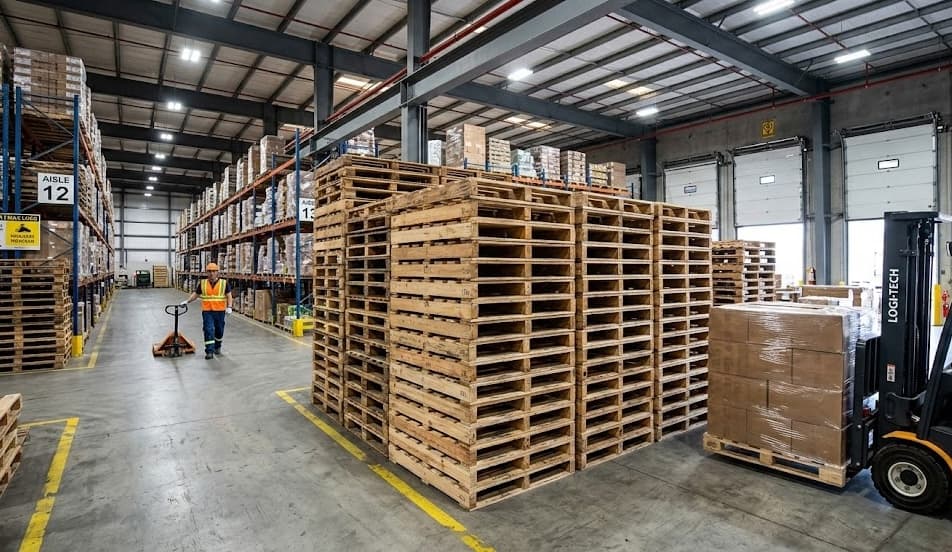
Building a Circular Economy, One Pallet at a Time
Sustainability isn't a marketing initiative for us — it's the core of our business model. Every pallet we touch either gets reused, repaired, or recycled. Nothing goes to waste.
The Circular Pallet Economy
Traditional pallet supply chains are linear: trees are cut, pallets are built, pallets are used, pallets are discarded. Our model is circular. We keep materials in productive use for as long as possible, then ensure they become inputs for other products — never waste.
Responsible Sourcing
New pallets use lumber from certified sustainable forestry operations. Used pallets are sourced locally, reducing transportation emissions and keeping materials in the regional economy.
Extended Life Cycles
Our grading and repair programs extend pallet life by 3-5 additional cycles. Every reuse cycle avoids the carbon cost of manufacturing a new pallet — roughly 22 lbs of CO2 per unit.
Collection & Buyback
We pick up used pallets from businesses across Southern California. Our buyback program creates financial incentive for businesses to return pallets instead of discarding them.
Repair, Chip, or Recycle
Repairable pallets are rebuilt. Irreparable wood becomes mulch or biomass fuel. Nails and fasteners are collected for steel recycling. Nothing reaches a landfill.
Carbon Footprint Tracking
We don't just claim to be green — we measure it. Our carbon tracking methodology is based on EPA waste reduction models and lifecycle analysis.
CO2 avoided per recycled pallet
Based on lifecycle analysis comparing new pallet manufacturing (forestry, milling, assembly, transport) against our repair-and-reuse model.
Total CO2 equivalent avoided to date
Cumulative impact since we began tracking in 2015. This figure includes both reuse diversions and wood-to-biomass energy offsets.
Wood diverted from landfill annually
Wood waste that would otherwise decompose in landfill, releasing methane — a greenhouse gas 28x more potent than CO2.
Steel recycled from nails annually
Every pallet contains 60-120 nails. We recover and recycle all fastener metal through a local steel recycler.
Wood Waste to Mulch & Biomass Pipeline
When a pallet can't be repaired or reused, we don't throw it away. The wood is chipped and sorted into two streams:
Landscape Mulch
Clean, untreated wood chips are processed into landscape-grade mulch. We supply local landscaping companies, community gardens, and municipal parks. Over 60 tons distributed annually.
Biomass Energy
Treated and mixed-species wood goes to our biomass energy partner, where it's burned to generate renewable electricity. This displaces fossil fuel consumption and keeps organic matter out of landfills where it would generate methane.
Steel Recycling from Nails & Fasteners
The average pallet contains 60 to 120 nails. When multiplied by thousands of pallets processed annually, that adds up to tons of steel. We use magnetic separation during the chipping process to recover all ferrous metals. The recovered steel is sent to a local recycler where it's melted down and remanufactured into new steel products — closing yet another material loop.
Steel recycled per year
Water Conservation in Operations
Pallet processing generates dust and requires periodic washing for food-grade and pharmaceutical applications. In drought-prone Southern California, water conservation isn't optional — it's essential.
In 2025, we installed rainwater collection systems and a greywater recycling loop at our processing facility. Collected rainwater is used for dust suppression during chipping operations. Greywater from pallet washing is filtered and recirculated. These systems have reduced our municipal water consumption by approximately 40%.
Water Impact
Sustainability Roadmap
Where we've been and where we're going.
Carbon Tracking Begins
Started measuring CO2 equivalent avoided per recycled pallet. Established baseline metrics and reporting methodology using EPA waste reduction models.
Zero-Landfill Commitment
Achieved and documented 100% landfill diversion for all pallet materials — wood, metal, and packaging. Third-party verified by processing logs and waste hauler reports.
Reforestation Partnership Launched
Partnered with San Diego Reforestation Project to plant native trees for every 1,000 pallets recycled. Over 200 trees planted to date across San Diego County watersheds.
50,000th Pallet Milestone
Recycled our 50,000th pallet and planted 50 trees to celebrate. Published our first annual sustainability report with full carbon accounting.
Biomass Energy Pipeline
Established a formal partnership with a local biomass energy facility. Irreparable wood chips now generate renewable energy instead of decomposing in landfill.
Water Conservation Program
Installed rainwater collection and greywater recycling systems at our processing facility. Reduced municipal water consumption by 40% for pallet washing and dust suppression.
Electric Fleet Transition
Beginning transition of our delivery fleet to electric and hybrid vehicles. First two electric trucks operational, with full fleet conversion planned by 2028.
Carbon Neutral Target
Our goal: achieve carbon neutrality across all operations — sourcing, processing, transportation, and facility energy. Offset remaining emissions through verified reforestation credits.
Our Sustainability Partners
San Diego Reforestation Project
We fund the planting of native trees in San Diego County watersheds. One tree planted per 1,000 pallets recycled.
Local Biomass Energy Facility
Irreparable wood chips are converted to renewable energy, displacing fossil fuel consumption in the regional grid.
Regional Steel Recycler
All nails and metal fasteners from pallet processing are collected, sorted, and recycled into new steel products.
Community Mulch Programs
Clean wood chips are donated to community gardens, school landscaping projects, and municipal parks departments.
Join Our Green Pallet Program
Whether you want to reduce your environmental footprint, meet ESG targets, or simply save money through pallet reuse — we can build a program that works for your business.
See Our Eco Impact DataHow We Calculate Carbon Savings
Our carbon footprint methodology is transparent and based on established lifecycle analysis models. Here is exactly how we calculate the environmental benefit of reusing and recycling pallets versus manufacturing new ones.
New Pallet Carbon Cost
Manufacturing a single new 48x40 wooden pallet generates approximately 22 lbs (10 kg) of CO2 equivalent when accounting for the full lifecycle:
Chainsaw fuel, skidder operation, road construction, replanting costs
Debarking, sawing, drying, electricity for mill operations
Log trucks from forest to mill, average 75-mile haul
Nailing machines, pneumatic tools, facility energy, nail manufacturing
Truck transportation from pallet manufacturer to end user
Methane from anaerobic decomposition in landfill over 20 years
Reused Pallet Carbon Cost
Reusing an existing pallet avoids most of the new-manufacturing carbon cost. The only emissions come from collection, inspection, repair, and redelivery:
Pickup truck fuel for local collection from customer sites
Facility energy for sorting operations, lighting, equipment
Replacement boards (partial new material), nail guns, labor
Local delivery within service area, shorter average haul
We report 22 lbs to include landfill methane avoidance for pallets that would otherwise be discarded
Putting Our Impact in Perspective
Raw carbon numbers can be abstract. Here is how our cumulative environmental impact translates into tangible equivalencies that are easier to understand.
Our annual CO2 avoidance (1.28M lbs) equals removing 59 passenger cars from the road for a full year. The average car produces 21,600 lbs of CO2 annually from fuel combustion.
The carbon sequestration equivalent of our cumulative CO2 savings equals the annual absorption capacity of 486 acres of mature US forest land.
By reusing pallets instead of manufacturing new ones, we have preserved the equivalent of 7,200 mature trees that would have been harvested for lumber. Each standard pallet requires approximately 0.0067 trees worth of lumber.
Our total CO2 avoidance is equivalent to the emissions from burning 650,000 gallons of gasoline, or roughly 26,000 full tank fill-ups for a standard sedan.
Water Usage Comparison
Wood pallet production requires significant water — from growing trees to sawmill processing to dust suppression during manufacturing. Our reuse model dramatically reduces water consumption across the entire supply chain.
New Pallet Manufacturing: ~8.2 gallons per pallet
Includes irrigation of managed forests, sawmill cooling and dust suppression, kiln drying condensate, and facility wash water
Our Reuse Process: ~0.6 gallons per pallet
Limited to inspection area wash-down and dust suppression during any repair work, using our recirculated greywater system
Annual Water Savings: ~45,600 gallons
Based on 6,000 pallets reused annually, avoiding 7.6 gallons of water consumption per pallet versus new manufacturing
Energy Savings Breakdown
The energy required to manufacture a new pallet is substantial — from diesel-powered forestry equipment to electricity-intensive sawmill operations. Reusing pallets avoids the vast majority of this energy consumption.
Forestry & Transport Energy: 12.4 kWh per new pallet
Diesel fuel for chainsaws, skidders, log trucks, and delivery vehicles converted to kilowatt-hour equivalents
Sawmill & Assembly Energy: 8.7 kWh per new pallet
Electricity for debarkers, band saws, planers, kiln dryers, nail guns, and conveyors in manufacturing plants
Reuse Processing Energy: 1.9 kWh per reused pallet
Forklift operation, pneumatic nail guns for repairs, sorting equipment, and facility operations
Net Energy Saved Per Pallet: 19.2 kWh
Equivalent to running a standard US household refrigerator for 13 days per pallet reused
The Circular Economy in Detail
The concept of a circular economy replaces the traditional "take-make-dispose" model with a closed-loop system where materials are continuously cycled back into productive use. In the pallet industry, this is not just an aspiration — it is a practical, profitable reality.
The Linear Problem
In a linear pallet economy, trees are harvested, pallets are manufactured, used once or twice, then discarded in landfills. This model:
- 1. Depletes forest resources faster than they regenerate
- 2. Fills landfills with usable wood (pallets are the #1 item in commercial landfills by volume)
- 3. Generates methane as wood decomposes anaerobically underground
- 4. Wastes the embedded energy, water, and labor from original manufacturing
- 5. Creates unnecessary transportation emissions hauling pallets to and from landfills
The Circular Solution
Our circular model keeps every component of a pallet in productive use for as long as physically possible:
- 1. Reuse: Pallets in good condition are resold directly, extending life by 3–5 more cycles
- 2. Repair: Damaged pallets get new boards, blocks, or stringers — cost is 40–60% of a new pallet
- 3. Remanufacture: Components from multiple pallets are combined to build functional units
- 4. Chip: Irreparable wood becomes mulch, animal bedding, or biomass fuel feedstock
- 5. Recycle: Nails and fasteners are magnetically separated and sent to steel recyclers
The Economic Benefit
Circular pallet practices are not just environmentally beneficial — they create measurable financial value at every stage:
- 1. Used pallets cost 30–60% less than new, saving buyers thousands per year
- 2. Buyback programs turn waste into revenue for businesses generating used pallets
- 3. Repair extends pallet life at a fraction of replacement cost
- 4. Mulch and biomass outputs create secondary revenue streams
- 5. Steel recycling from nails generates additional material value
- 6. Reduced landfill disposal costs for all participants in the circular system
Sustainability Certifications and Standards
We align our operations with recognized industry standards and certifications to ensure our sustainability claims are verifiable and credible.
Zero Landfill Verification
Achieved 2018Our zero-landfill commitment is verified through processing logs, waste hauler manifests, and material flow tracking. Every piece of wood, metal, and packaging that enters our facility has a documented destination that is not a landfill. We maintain a chain of custody for all materials from intake to output.
ISPM 15 Heat Treatment Certification
ActiveOur heat treatment operations are certified under ISPM 15 (International Standards for Phytosanitary Measures), with our facility registered through the USDA APHIS program. This allows us to produce export-compliant pallets with the official IPPC stamp, ensuring our clients' international shipments meet phytosanitary requirements worldwide.
NWPCA Membership
Active MemberWe are an active member of the National Wooden Pallet and Container Association (NWPCA), which sets industry standards for pallet grading, manufacturing, and safety. Our grading criteria aligns with NWPCA guidelines, and we participate in industry data sharing that improves environmental benchmarking across the pallet sector.
SFI / FSC Chain of Custody
Supplier VerifiedFor new pallet construction, we source lumber from mills that maintain Sustainable Forestry Initiative (SFI) or Forest Stewardship Council (FSC) chain of custody certification. This ensures that the virgin wood entering our supply chain comes from responsibly managed forests with verified reforestation and biodiversity protection practices.
2025 Annual Environmental Report Highlights
Each year we publish a comprehensive environmental report documenting our sustainability performance. Here are the key metrics and achievements from our most recent reporting period.
Pallets Recycled (Cumulative)
+16% YoY
Pallets Recycled in 2025
+12% vs 2024
Lbs CO2 Avoided in 2025
Equivalent to 8.5 cars
Landfill Diversion Rate
8th consecutive year
Key Achievements in 2025
- Installed rainwater collection and greywater recycling systems, reducing municipal water consumption by 40%
- Achieved 97% nail recovery rate with new automated magnetic separation equipment
- Distributed over 60 tons of landscape mulch to community gardens and municipal parks
- Planted 42 native trees through our San Diego Reforestation Project partnership
- Published first quarterly carbon reports for clients with ESG reporting requirements
- Began electric fleet transition with first two electric delivery trucks
2026 Targets
- Recycle 10,000 pallets (20% increase over 2025)
- Install solar panels at processing facility to offset 30% of electricity consumption
- Add two more electric trucks to fleet, reaching 50% electric delivery coverage
- Achieve 99% nail recovery rate through equipment optimization
- Launch a client-facing carbon dashboard for real-time impact tracking
- Plant 60 native trees through expanded reforestation partnership
Request the Full Report
Our complete 2025 Annual Environmental Report includes detailed methodology, data tables, third-party verification notes, and year-over-year trend analysis. Available on request for clients, prospective partners, and sustainability professionals.
Contact info@sandiegopallet.com to request a copy.
Frequently Asked Questions
What is your zero-landfill commitment?
Since 2017, 100% of pallets we process are either resold, repaired, chipped for mulch or biomass fuel, or have their steel nails recycled. Zero wood waste goes to landfill, verified by our processing logs.
How do you track your environmental impact?
We log every pallet by grade, condition, weight, and destination. This data drives our CO2 calculations, waste diversion metrics, water savings estimates, and energy conservation reporting using peer-reviewed lifecycle data.
Do you provide sustainability reports for clients?
Yes. Every recycling program client receives quarterly impact reports documenting pallets recycled, CO2 avoided, wood diverted, and water saved. Reports are formatted for GRI, SASB, and CDP ESG frameworks.
What are your carbon neutrality goals?
We plan to achieve carbon-neutral operations by 2028 through solar power installation (planned 2026), electric fleet transition (starting 2027), and verified carbon offset programs for remaining Scope 1 and 2 emissions.
How does pallet recycling reduce carbon emissions?
Each recycled pallet avoids 18.7 lbs of CO2 compared to manufacturing new. Recycling uses 85% less energy, 88% less water, and 85% less lumber than new production, based on USDA Forest Products Laboratory data.
Start a Sustainability Conversation
Tell us about your sustainability goals and we'll design a pallet program to support them.