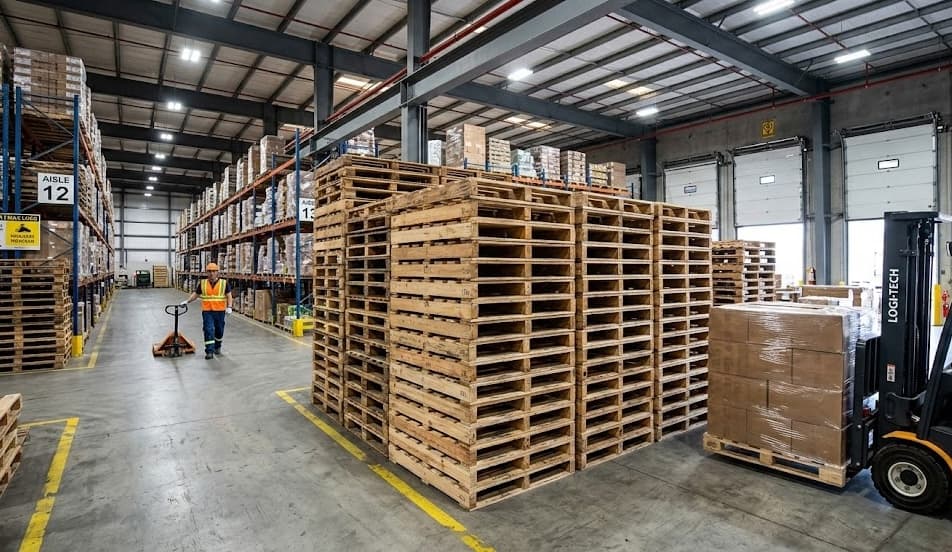
ISPM 15 Heat Treatment — Ship Anywhere
International shipping regulations require heat-treated wood packaging. We provide fully certified HT pallets and can treat your existing inventory.
What Is Heat Treatment?
Heat treatment (HT) is a phytosanitary process mandated by the International Standards for Phytosanitary Measures No. 15 (ISPM 15). It requires raising the core temperature of all wood packaging material to at least 56 degrees Celsius (132.8 F) and holding it there for a minimum of 30 continuous minutes.
The purpose is simple: eliminate insects, larvae, and pathogens that could hitch a ride on untreated wood and devastate ecosystems in the destination country. Without proper HT certification, your shipments can be rejected at port, delayed indefinitely, or destroyed.
Over 180 countries enforce ISPM 15 requirements. If you ship internationally on wood pallets, crates, or dunnage, you need heat-treated wood.
ISPM 15 at a Glance
- StandardISPM 15 (FAO / IPPC)
- Core Temperature56 C / 132.8 F minimum
- Hold Duration30 minutes continuous
- Applies ToAll solid wood packaging > 6mm
- Proof of ComplianceIPPC/HT stamp on each unit
- Countries Enforcing180+
Our Heat-Treatment Process
Inspection & Loading
Each pallet is inspected for structural integrity and loaded into our industrial heat-treatment kiln in organized stacks.
Core Temperature Ramp
The kiln raises the core wood temperature to a minimum of 56 C (132.8 F). We monitor with embedded probes to ensure even distribution.
30-Minute Hold
Once core temp reaches 56 C, the clock starts. We hold for a minimum of 30 continuous minutes as required by ISPM 15 standards.
Cooling & Stamping
Pallets cool naturally, then receive the official IPPC/HT stamp proving compliance. Each batch is logged for full traceability.
Heat Treated vs. Untreated vs. Alternatives
| Feature | HT Wood Pallet | Untreated Wood | Plastic Pallet | Plywood / OSB |
|---|---|---|---|---|
| ISPM 15 Compliant | Yes (with stamp) | No | Exempt | Exempt (if processed) |
| International Shipping | Accepted worldwide | Rejected at border | Accepted worldwide | Accepted (conditions apply) |
| Cost per Unit | $18 - $28 | $12 - $18 | $35 - $65 | $25 - $45 |
| Load Capacity | 2,500 - 4,800 lbs | 2,500 - 4,800 lbs | 2,000 - 3,000 lbs | 1,500 - 2,500 lbs |
| Reusable / Repairable | Yes | Yes | Yes (not repairable) | Limited |
| Best For | Export & domestic | Domestic only | Clean environments | One-way export |
Heat-Treatment Pricing
Standard HT
$3.50 - $5.00
per pallet
- 48x40 GMA pallets
- Batch processing
- 3-5 day turnaround
- IPPC/HT stamp included
100 pallet minimum
Rush HT
$6.00 - $8.00
per pallet
- Any standard size
- Priority kiln scheduling
- 1-2 day turnaround
- IPPC/HT stamp included
50 pallet minimum
Custom / Oversized
Call for quote
per piece
- Crates, dunnage, skids
- Non-standard dimensions
- Individual probing available
- Full documentation package
No minimum
Who Needs Heat-Treated Pallets?
International Exporters
Any company shipping goods overseas on wood packaging must comply with ISPM 15 to clear customs in 180+ countries.
Freight Forwarders
Avoid costly port delays and rejections by ensuring every pallet in your container carries a valid HT stamp.
Food & Agriculture
USDA and FDA-regulated products often require heat-treated wood packaging as an additional phytosanitary safeguard.
Government & Military
Defense logistics and government contracts almost universally require ISPM 15 certified wood packaging materials.
Pharmaceutical Shippers
Temperature-sensitive supply chains need verified pest-free wood to prevent contamination and regulatory violations.
Automotive Supply Chain
OEMs and tier-one suppliers shipping parts internationally need HT-stamped pallets to keep assembly lines on schedule.
Non-Compliance Can Be Costly
Shipping on untreated wood packaging to a country that enforces ISPM 15 can result in shipment rejection, quarantine fees, fumigation costs, or complete destruction of goods. A single non-compliant pallet in a container can hold up the entire load. The cost of heat treatment is a fraction of the cost of a delayed or rejected shipment. Get it right the first time.
ISPM 15: The Complete Guide for Shippers
ISPM 15 is the single most important regulation in international wood packaging. If you ship goods on wooden pallets, crates, or dunnage to any country outside your own, this standard applies to you. Here is everything you need to know.
What ISPM 15 Requires
The International Standards for Phytosanitary Measures No. 15, developed by the Food and Agriculture Organization (FAO) of the United Nations under the International Plant Protection Convention (IPPC), requires that all wood packaging materials (WPM) used in international trade be treated to eliminate pests. The standard was first adopted in 2002 and has been revised several times, most recently in 2019.
The regulation applies to any solid wood packaging thicker than 6mm used to support, contain, or protect commodities during international transport. This includes pallets, crates, dunnage (loose wood used to brace cargo), skids, packing blocks, drums, and similar wood packaging. It does NOT apply to processed wood products like plywood, OSB, particle board, or veneer, because the manufacturing process eliminates pest risk.
Two treatment methods are approved under ISPM 15: heat treatment (HT) and methyl bromide fumigation (MB). However, methyl bromide is being phased out globally under the Montreal Protocol due to ozone depletion. Heat treatment is now the standard method used by nearly all compliant facilities, including ours.
Why It Exists
Untreated wood is a highway for invasive species. Insects like the Asian Longhorned Beetle, Emerald Ash Borer, and Pine Wood Nematode have devastated forests in countries where they were introduced through contaminated wood packaging. The economic damage from these invasions runs into billions of dollars annually worldwide.
The Asian Longhorned Beetle alone has cost the United States over $600 million in eradication efforts since its detection in 1996, traced back to untreated wood packaging from China. The Emerald Ash Borer has killed hundreds of millions of ash trees across North America. ISPM 15 was created specifically to prevent these kinds of introductions.
By requiring heat treatment to 56 degrees Celsius for 30 minutes, the standard ensures that all life stages of wood-boring insects, nematodes, and fungal pathogens are eliminated before the wood crosses an international border. This temperature and duration were scientifically validated to kill 100% of known wood-transmitted pests.
Inside the Kiln: Step-by-Step Treatment Process
Our heat treatment process follows a precise protocol with multiple quality checkpoints. Here is exactly what happens to your pallets from arrival to certification.
Step 1: Pre-Treatment Inspection
~15 minutes per batchEvery pallet is visually inspected for structural damage, foreign objects, and existing treatment marks. Pallets with metal hardware (bolts, brackets) that could become heat sinks are flagged for probe placement near those areas. Pallets that are too damaged for treatment are pulled and redirected to repair or recycling. We document the batch with a unique lot number that follows it through the entire process.
Step 2: Kiln Loading & Probe Placement
~30 minutes per batchPallets are stacked in the kiln with spacers to ensure even air circulation on all sides. Our kiln accommodates up to 200 standard 48x40 pallets per batch. Temperature probes are inserted into the core of the thickest wood sections in at least 3 representative pallets per batch. Probe placement targets the center of blocks, the thickest stringers, and any areas identified during inspection as potential cold spots. Probes are connected to our data logging system.
Step 3: Temperature Ramp-Up
3-6 hours depending on wood moisture contentThe kiln brings chamber temperature up gradually to avoid surface checking and cracking. Our gas-fired kiln reaches operating temperature of 75-80 degrees Celsius at the air level while we monitor core wood temperatures climbing toward the 56-degree target. Higher moisture content wood takes longer because water must be heated before the wood temperature can rise. We never rush this phase because uneven heating can leave cold pockets in the center of thick components.
Step 4: 30-Minute Hold at 56 C Core
Exactly 30 minutes minimumOnce ALL probes read 56 degrees Celsius or above at the wood core (not surface, not air temperature, but actual core), the 30-minute hold timer starts. If any single probe drops below 56 degrees during the hold, the timer resets to zero. Our data logging system records temperature at 60-second intervals throughout the hold period, creating a continuous temperature record that constitutes our proof of compliance.
Step 5: Cool-Down & Inspection
2-4 hours natural coolingAfter the hold period is complete, the kiln is opened and pallets cool naturally. We do not use forced cooling because rapid temperature changes can cause wood to crack. During cool-down, we inspect for any treatment-induced damage (checking, warping, or split ends). Pallets that suffered damage during treatment are pulled for repair before stamping.
Step 6: Stamping & Documentation
~5 seconds per palletEach pallet receives the official IPPC stamp using our registered mark. The stamp includes: the IPPC logo (wheat sheaf), our country code (US), our unique facility registration number, and the treatment code (HT for heat treatment). The stamp is applied with a branding iron or stencil ink on at least two sides of the pallet for visibility during customs inspection. The batch documentation is filed and linked to the lot number for full traceability.
Export Country Requirements & Enforcement
While ISPM 15 is an international standard, enforcement varies by country. Some countries inspect every container; others sample randomly. Here is what you need to know about the most common export destinations from Southern California.
| Destination | ISPM 15 Required | Enforcement Level | Special Notes |
|---|---|---|---|
| Mexico | Yes | High | Strict inspection at all border crossings. Frequent rejections for missing or illegible stamps. Mexico also requires phytosanitary certificate for some agricultural commodities. |
| Canada | Yes | Moderate | CBSA inspects wood packaging during random audits. Non-compliant shipments may be fumigated at shipper expense or returned. |
| China | Yes | Very High | AQSIQ inspects thoroughly. Non-compliant wood packaging results in fumigation at port ($500-2,000) or container rejection. China also requires additional documentation for some wood species. |
| European Union | Yes | High | All 27 EU member states enforce ISPM 15. National Plant Protection Organizations conduct inspections at ports of entry. Penalties vary by country. |
| Australia | Yes | Very High | Australia has the strictest biosecurity in the world. 100% of wood packaging is inspected. Any non-compliance results in treatment at port, re-export, or destruction. Costs are charged to the importer. |
| Japan | Yes | High | MAFF conducts rigorous inspections. Japan additionally requires that treated pallets be free of bark, which is not an ISPM 15 requirement but a Japanese national regulation. |
| South Korea | Yes | High | QIA inspects at all ports. Requires clear, legible IPPC stamp. South Korea has rejected shipments where stamps were partially obscured by shrink wrap or strapping. |
| India | Yes | Moderate-High | Plant Quarantine Order enforces ISPM 15. Fumigation at port is common for non-compliant shipments. Processing times at Indian ports can add 5-10 days to delivery. |
Compliance Documentation & Traceability
A stamp on the pallet is the minimum requirement. We provide comprehensive documentation that protects you if a customs authority questions your compliance.
What You Receive
- IPPC/HT stamp on every treated pallet (minimum 2 sides)
- Certificate of Treatment with lot number, date, quantity, and treatment parameters
- Temperature data log showing continuous probe readings throughout the hold period
- Batch traceability record linking your order to specific kiln run and documentation
- Digital copies of all certificates emailed on day of treatment completion
- Physical copies included with pallet delivery if requested
The IPPC Stamp Explained
The IPPC stamp is the internationally recognized proof of ISPM 15 compliance. Every element of the stamp has a specific meaning that customs officials are trained to read:
The wheat sheaf symbol of the International Plant Protection Convention, proving the stamp is issued by an authorized agency.
Identifies the country where treatment was performed. US indicates treatment in the United States.
A unique number assigned to our facility by APHIS (Animal and Plant Health Inspection Service). This number can be traced back to our specific treatment operation.
Identifies the treatment method. HT means heat treatment. MB means methyl bromide (rarely used). DH means dielectric heating (microwave). If you see HT, the wood was kiln-heated to 56 C for 30 minutes.
Re-Treatment After Repair
An important detail many shippers overlook: if a heat-treated pallet is repaired using untreated wood, the entire pallet loses its ISPM 15 compliance. Every replacement board, stringer, or block added to a treated pallet must itself be heat-treated. If you have pallets that were treated, then repaired with unknown wood, they need re-treatment before export. We inspect for mixed treated/untreated components and can re-treat pallets that have been repaired with non-compliant materials.
Temperature Requirements & Why They Matter
The 56 degrees Celsius / 30 minutes requirement is not arbitrary. It is the result of extensive research into the thermal mortality thresholds of wood-boring organisms.
Core Temperature vs. Air Temperature
The 56 C requirement applies to the CORE of the wood, not the air inside the kiln. This distinction matters because wood is an insulator. When the air temperature reaches 56 C, the center of a 4-inch thick block might only be at 35 C. Our kiln air temperature runs at 75-80 C to ensure the core of the thickest wood component reaches 56 C in a reasonable time frame. This is why probe placement in the center of the thickest component is critical.
Moisture Content Effects
Green (freshly cut) lumber with 30%+ moisture content takes significantly longer to heat treat than kiln-dried lumber at 12-15% moisture. Water has a higher specific heat capacity than wood, meaning it takes more energy to raise its temperature. Wet pallets can take twice as long to reach core temperature, which is why we assess moisture content during pre-treatment inspection and adjust our kiln schedules accordingly.
Why 56 Degrees Specifically
Research conducted by the USDA Forest Service and international partners established that 56 C for 30 minutes achieves 100% mortality of all known wood-boring insects at all life stages (eggs, larvae, pupae, adults) and effectively kills nematodes and fungal pathogens. This temperature was chosen as the minimum threshold that guarantees pest elimination while minimizing heat damage to the wood. Higher temperatures work faster but can cause checking, warping, and reduced nail holding capacity.
Minimum core wood temperature
Minimum hold time at 56 C
Typical kiln air temperature
Temperature logging interval
Frequently Asked Questions
What is ISPM 15 heat treatment for pallets?
ISPM 15 is an international standard requiring wood packaging materials to be heat-treated to a core temperature of 56°C (132.8°F) for a minimum of 30 minutes. This eliminates pests and pathogens that could spread through international trade.
How long does the heat treatment process take?
The complete process takes 6-8 hours including loading, temperature ramp-up, the required 30-minute hold at 56°C core temperature, cool-down, and unloading. We monitor with embedded temperature probes throughout.
Can used pallets be heat treated?
Yes. Both new and used pallets can be heat treated to meet ISPM 15 requirements. We inspect used pallets for structural integrity before treatment to ensure they meet export standards after the process.
How do I verify a pallet is ISPM 15 certified?
Certified pallets carry an IPPC stamp showing the treatment code (HT for heat treatment), our facility registration number, and the country code. We provide documentation for customs clearance with every treated order.
Which countries require heat-treated pallets?
Most countries require ISPM 15 compliant wood packaging for imports, including the EU, China, Australia, Canada, and Mexico. Requirements vary by country, and we can advise on specific destination requirements for your shipments.
Request Heat Treatment
Tell us the pallet type, size, and quantity you need treated.