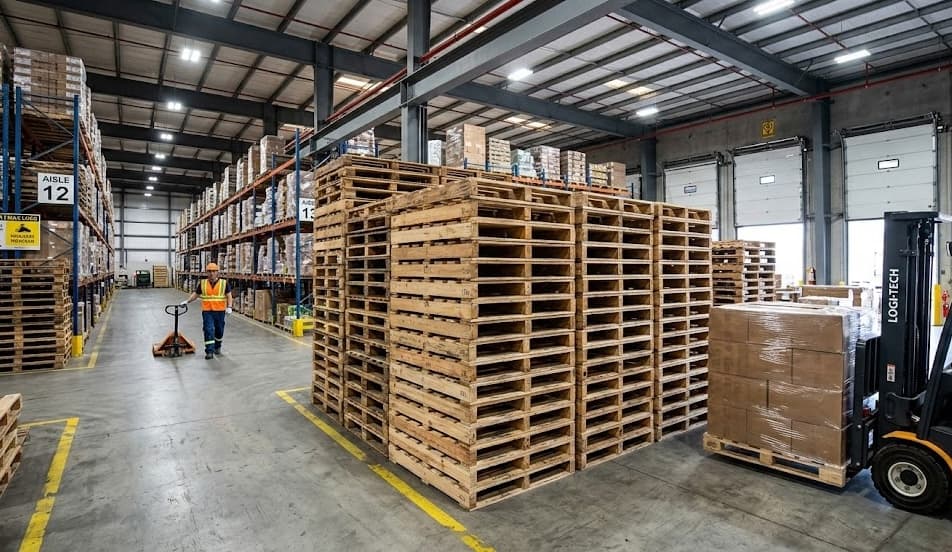
New Pallets — When Only New Will Do
Sometimes you need a guaranteed-new pallet. We have them — heat-treated, block, and plastic variants in every standard configuration.
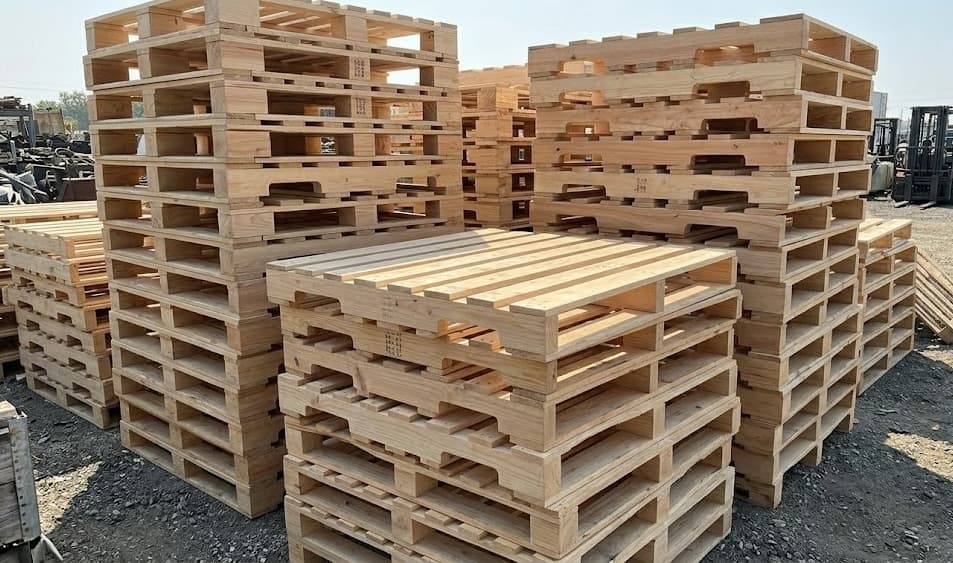
Standard New Wood
From $15–$22 / pallet
- 48×40 GMA standard
- 2,500 lb capacity
- HT certified
- 6-board deck
Best for: General warehousing, retail distribution
Heavy-Duty Block
From $28–$40 / pallet
- 48×40 or custom
- 4,800 lb capacity
- 9-block construction
- Forklift entry all sides
Best for: Heavy manufacturing, automotive
ISPM 15 Export
From $18–$28 / pallet
- Certified heat-treated
- IPPC/HT stamp
- All sizes available
- International shipping ready
Best for: Overseas shipping, import/export
Plastic New
From $35–$65 / pallet
- HDPE construction
- Rackable to 3,000 lbs
- Washable, FDA-grade
- 30+ year lifespan
Best for: Food, pharma, cleanroom environments
💡 Consider Used First
New pallets are great, but used Grade A pallets often meet the same specifications at 50%+ savings. Ask us to compare options for your specific use case — we'll always give you an honest recommendation.
How Our New Pallets Are Built
Every new pallet we manufacture follows strict National Wooden Pallet and Container Association (NWPCA) standards and meets or exceeds GMA specifications. Our manufacturing process ensures consistency, structural integrity, and compliance from the first pallet to the ten-thousandth.
Lumber Selection & Grading
All lumber is graded per NHLA (National Hardwood Lumber Association) or SPIB (Southern Pine Inspection Bureau) standards before entering our production line. We reject lumber with wane exceeding 1/3 of the board face, through-knots larger than 1.5 inches, and any evidence of decay or insect damage. Moisture content is verified at 19% or below for standard builds and 12% or below for heat-treated pallets.
Precision Assembly
Our pneumatic nailing systems drive 2.25-inch ring-shank nails at precisely controlled depth — flush with the deck surface but never over-driven. Each standard 48x40 stringer pallet receives 62 nails minimum. Block pallets receive 84+ nails. Every nail is positioned per the NWPCA Pallet Design System (PDS) engineering specifications to maximize load distribution and joint strength.
Quality Control Checkpoints
Three quality checkpoints during assembly: after stringer/block placement, after bottom deck nailing, and after top deck completion. Random sampling at a rate of 1-per-50 pallets undergoes destructive testing — loaded to 150% of rated capacity to verify structural margins. Any production run with a failure rate above 0.5% triggers a line shutdown and full batch re-inspection.
Compliance Documentation
Every batch ships with a Certificate of Compliance documenting lumber species, moisture content, nail specifications, heat treatment records (when applicable), and load test results. For ISPM 15 orders, we provide IPPC certification with our registered facility stamp. Documentation is available in digital format for your records management system.
Wood Species We Use — And Why It Matters
The wood species in your pallet directly impacts its load capacity, weight, durability, and cost. We stock multiple species and can recommend the best match for your specific application.
Southern Yellow Pine (SYP)
The industry standard for pallet manufacturing in North America. Southern Yellow Pine offers an excellent strength-to-weight ratio with a specific gravity of 0.51-0.59. It nails cleanly, resists splitting, and accepts heat treatment uniformly. SYP deck boards rated at #2 Common grade deliver 1,200+ PSI in bending strength — more than sufficient for standard GMA loads.
Oak (Red & White)
When load capacity is the top priority, oak delivers. With a specific gravity of 0.63-0.68 and bending strength exceeding 14,000 PSI, oak pallets handle the heaviest loads in the catalog. The trade-off is weight — an oak 48x40 pallet weighs 55-65 lbs versus 40-48 lbs for SYP. Oak is the preferred species for automotive, steel, machinery, and heavy manufacturing applications.
Mixed Hardwood
Our mixed hardwood pallets combine species like poplar, maple, birch, and ash to deliver solid performance at the lowest hardwood price point. Specific gravity ranges from 0.45-0.56 depending on the species mix. Mixed hardwood is perfect for domestic shipping applications where you need more strength than softwood but don't require the premium performance of pure oak or SYP.
Heat Treatment — The Export Standard
ISPM 15 (International Standards for Phytosanitary Measures No. 15) is a mandatory international regulation that requires all solid wood packaging materials to be treated before crossing borders. Here is everything you need to know about the heat treatment process and how it affects your pallets.
The Heat Treatment Process
1. Loading
Pallets are loaded into our industrial heat-treatment kiln in batches of 200-400 units. Temperature probes are inserted into the thickest lumber components (typically the center blocks on block pallets or the middle stringer on stringer pallets) to monitor core temperature.
2. Heating
The kiln raises temperature gradually over 4-6 hours until the core of every wood component reaches 56 degrees Celsius (132.8 degrees Fahrenheit). Rapid heating is avoided to prevent surface checking and board warping.
3. Hold Period
Once core temperature reaches 56 degrees C, it is maintained for a minimum of 30 continuous minutes. Our standard protocol holds for 45 minutes to ensure 100% compliance even in the thickest lumber sections.
4. Cooling & Stamping
Pallets cool naturally in the kiln for 2-4 hours, then are removed and stamped with our registered IPPC/HT mark. The stamp includes our facility registration number, the treatment code (HT), and the country code (US).
Why Heat Treatment Matters
Is it legally required?
Yes, for all solid wood packaging entering or transiting through any of the 180+ countries that enforce ISPM 15. Non-compliant shipments are refused entry, quarantined, or destroyed at the shipper's expense.
Does it weaken the wood?
No. Heat treatment at 56 degrees C does not reduce the structural strength of wood. In fact, the controlled drying slightly increases stiffness. The process does reduce moisture content to 12-15%, which helps prevent mold during ocean transit.
How do I verify compliance?
Look for the IPPC wheat-sheaf logo stamped on at least two sides of the pallet, along with the country code, producer number, and treatment code (HT or MB). We provide compliance certificates with every HT order.
What about re-treatment?
If a heat-treated pallet is repaired with new wood, the entire pallet must be re-treated before export. We offer re-treatment services for $2-$4 per pallet depending on volume.
Export tip: If you ship to Canada, Mexico, EU, China, Australia, or Japan, you need ISPM 15 compliant pallets — no exceptions. We recommend ordering 10-15% extra HT pallets to cover damaged replacements without delaying your shipment schedule.
New Pallets in Any Size You Need
While the 48x40 GMA standard dominates the market, hundreds of industries require non-standard dimensions for their specific containers, products, and racking systems. We manufacture new pallets to any specification.
Industry standard. Fits standard 53-foot trailers (21 pallets per load). Compatible with all major retailer DC requirements.
Used extensively in telecommunications equipment, paint manufacturing, and chemical distribution.
Designed for 55-gallon drum storage. Accommodates 4 drums per pallet in 2x2 configuration. Also popular for square bulk containers.
Common in government logistics and chemical distribution. Slightly wider than GMA for specialized container clearance.
Compact footprint for dairy crate stacking and beverage case configurations. Optimized for walk-in cooler dimensions.
Narrow-format pallet for bottling lines and compact conveyor systems. Fits tight aisle racking configurations.
Quarter-pallet size for retail point-of-purchase displays and small shipments. Fits through standard doorways.
From 24x24 up to 72x120 — we cut and build to your exact measurements. Engineering review included for non-standard builds.
Our New Pallet Warranty
Every new pallet we manufacture is backed by a comprehensive structural warranty. If any new pallet fails under loads at or below its rated capacity within the warranty period, we replace it at no cost — including delivery.
Standard New Pallets
12-month warranty covering structural failure under rated dynamic, static, and racking loads. Covers board splits, stringer fractures, nail pull-through, and joint separation under normal handling conditions.
Heavy-Duty Block Pallets
18-month warranty with the same structural coverage plus additional protection against block compression failure and deck board deflection under rated racking loads.
Plastic Pallets
5-year limited warranty against manufacturing defects. Does not cover damage from impact, overloading, or chemical exposure beyond the pallet's rated specifications.
What's Not Covered
Overloading beyond rated capacity, forklift impact damage, exposure to chemicals or fire, modifications made after delivery, and normal wear from expected trip cycles.
Bulk Pricing Tiers
New pallet pricing drops significantly with volume. Here are our standard pricing tiers — custom quotes are available for annual contracts and scheduled recurring orders.
Standard pricing for small orders and project-based needs.
Most common tier for small-to-mid businesses. Free San Diego delivery included.
Dedicated production run. Priority scheduling and quality documentation included.
Volume production pricing. Locked rate for 60 days. Scheduled delivery options.
Contract pricing. Dedicated account manager. Inventory reservation. Weekly delivery scheduling.
Annual contracts: Businesses ordering 200+ new pallets per month qualify for annual contract pricing — the deepest discounts we offer. Includes guaranteed pricing for 12 months regardless of lumber market fluctuations, priority production scheduling, and a dedicated account manager.
Frequently Asked Questions
What types of new pallets do you offer?
We offer standard new wood pallets (GMA 48x40), heavy-duty block pallets for industrial loads, export-grade ISPM 15 certified pallets, and custom-built pallets in any dimension or specification you require.
Are your new pallets heat-treated and ISPM 15 certified?
Yes. All our new pallets can be heat-treated to ISPM 15 standards for international shipping. Heat-treated pallets carry the official IPPC stamp with our facility registration number for customs clearance.
What is the lead time for new pallet orders?
Standard new pallets from stock ship same-day or next-day. Custom new builds typically take 3-5 business days from specification approval to delivery, depending on complexity and volume.
Can you build new pallets to custom specifications?
Absolutely. We engineer and build custom pallets to your exact dimensions, wood species, load ratings, and finish requirements. We provide design review and load testing documentation for specialty applications.
What wood species are available for new pallets?
We build with Southern Yellow Pine (most common), Oak and hardwoods for heavy-duty applications, and kiln-dried softwood for food-grade requirements. Species selection depends on your load, compliance, and budget needs.
Order New Pallets
Tell us type, specs, and quantity.