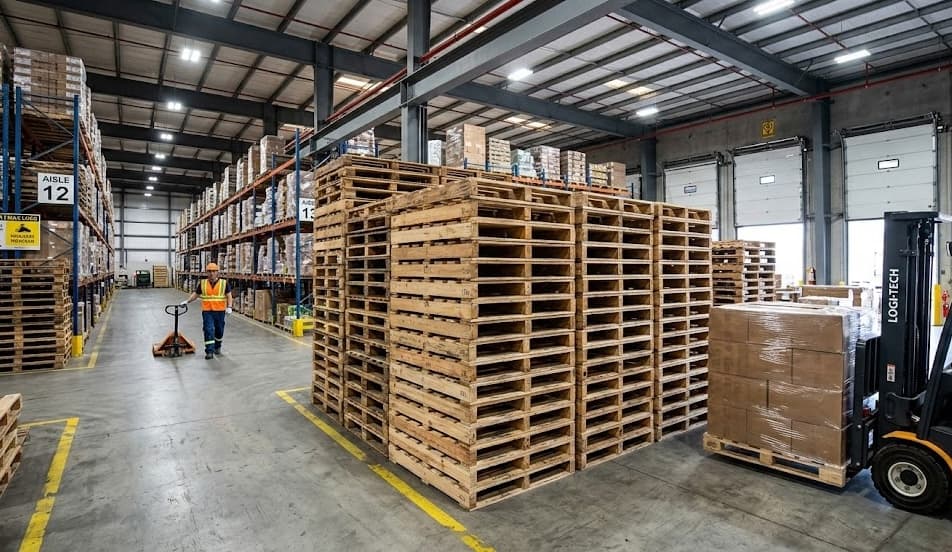
Food-Safe Pallets — Zero Compromise
The food and beverage industry demands the highest standards for packaging materials. Our pallets meet FDA, FSMA, and HACCP requirements out of the box.
Why Food & Beverage Is Different
When pallets carry food products, the stakes are higher than in any other industry. A contaminated pallet can lead to product recalls, regulatory fines, and brand damage that takes years to recover from.
The FDA's Food Safety Modernization Act (FSMA) places responsibility on every link in the supply chain, including packaging materials. Your pallets must be free of chemical contaminants, biological hazards, and physical debris. Heat treatment eliminates pest risk, and proper material selection prevents chemical leaching.
We supply pallets specifically selected and processed for food contact applications, whether you need heat-treated wood for dry goods distribution or FDA-grade plastic for wet processing environments.
Compliance Standards We Meet
Pallet Types for Food & Beverage
| Feature | HT Wood (New) | HT Wood (Recon) | HDPE Plastic | Presswood |
|---|---|---|---|---|
| FDA Food Contact | Yes | Grade A only | Yes | Yes |
| Washable / Sanitizable | Limited | Limited | Fully washable | Not recommended |
| Cold Storage (-20 F) | Good | Good | Excellent | Poor (absorbs moisture) |
| Wet Environments | Fair (can mold) | Fair (can mold) | Excellent | Poor |
| Load Capacity | 2,500 - 4,800 lbs | 2,500 - 4,000 lbs | 2,000 - 3,000 lbs | 1,500 - 2,200 lbs |
| Cost per Unit | $18 - $28 | $6 - $12 | $35 - $65 | $8 - $14 |
| Lifespan (trips) | 15 - 25 | 8 - 15 | 100+ | 1 - 3 |
| Best Application | Dry goods, export | Warehouse distribution | Processing, cold chain | One-way export |
Key Considerations for Food Supply Chains
Cold Storage & Freezer Use
Freezer environments (-20 F and below) cause wood to become brittle over time. For high-cycle cold chain operations, plastic pallets are the better long-term investment despite higher upfront cost.
Wet Processing Areas
Meat, dairy, and beverage facilities with wash-down protocols need pallets that will not absorb water, harbor bacteria, or develop mold. HDPE plastic is the standard here.
Heat Treatment for Export
If you export food products internationally, your wood pallets must be ISPM 15 heat-treated. We stamp every treated pallet with the official IPPC mark for customs clearance.
Pallet Debris & Splinters
Loose nails, wood splinters, and sawdust are physical contamination hazards in food facilities. Our Grade A pallets are inspected for protruding fasteners and surface defects.
Chemical Treatment History
We never supply pallets that have been chemically treated with methyl bromide (MB) for food applications. All our food-grade wood pallets are heat-treated only.
Audit & Traceability
SQF and BRC audits may require pallet sourcing documentation. We provide certificates of treatment, material origin records, and batch traceability on request.
Our Food & Beverage Solutions
Hygienic Wood Program
- New heat-treated GMA pallets
- Grade A inspected, no splinters or debris
- IPPC/HT stamped for export
- Available in standard and custom sizes
From $18/pallet
Plastic Pallet Program
- FDA-grade HDPE construction
- Fully washable and sanitizable
- Rated for cold storage to -40 F
- 100+ trip lifespan
From $35/pallet
Managed Pallet Program
- We manage your entire pallet supply
- Scheduled deliveries and pickups
- Quality inspections before every delivery
- Monthly reporting and invoicing
Custom pricing
Need Help Choosing?
The right pallet for your food operation depends on your specific environment, product type, and supply chain. Our team has worked with bakeries, meat processors, beverage distributors, and cold chain logistics companies across Southern California. We can recommend the most cost-effective solution that passes your next audit. Learn about our consulting services.
FDA Regulations for Food Pallets
The regulatory landscape for food-contact packaging materials is extensive and evolving. Understanding these requirements is critical to avoiding costly violations, product recalls, and supply chain disruptions.
Food Safety Modernization Act (FSMA)
Signed into law in 2011, FSMA represents the most significant overhaul of food safety regulations in over 70 years. Under FSMA, the FDA shifted from responding to foodborne illness outbreaks to preventing them. This has direct implications for pallet selection.
FSMA's Preventive Controls for Human Food rule (21 CFR Part 117) requires food facilities to implement a written food safety plan that identifies and addresses known or reasonably foreseeable hazards. Pallets are classified as a "food-contact surface" when they directly touch food packaging, which means they must be:
- Free from chemical contaminants — no methyl bromide (MB) treatment
- Free from biological hazards — heat-treated to eliminate pests, mold, and bacteria
- Free from physical hazards — no splinters, loose nails, sawdust, or wood fragments
- Made from materials that do not leach harmful substances into food products
- Cleanable and maintainable in a sanitary condition
- Traceable to a documented source with treatment records available on request
FSMA Sanitary Transportation Rule
The Sanitary Transportation of Human and Animal Food rule (21 CFR Part 1, Subpart O) establishes requirements for vehicles and transportation equipment used to transport food. Pallets used during food transport are considered part of the transportation equipment.
Key requirements under this rule that affect pallet selection:
- Pallets must be designed and maintained to prevent food from becoming unsafe during transport
- Shippers must specify pallet requirements in written agreements with carriers
- Temperature-controlled pallets must not introduce condensation or moisture that could contaminate food
- Pallets previously used to transport non-food items (chemicals, waste) cannot be reused for food without documented decontamination
- Records of pallet condition and compliance must be maintained for a minimum of 12 months
Violation consequence: FDA can issue warning letters, mandate recalls, and impose injunctions. In severe cases, criminal prosecution is possible with fines up to $500,000 and imprisonment up to 3 years under 21 USC 333.
21 CFR 110 — Current GMP
Current Good Manufacturing Practice regulations require that all food-contact surfaces, including pallets, be maintained in a clean and sanitary condition. Surfaces must be non-toxic, non-absorbent where possible, and resistant to corrosion and deterioration from cleaning agents. Wood pallets in GMP environments must be inspected before each use for mold, staining, odor, and structural damage.
FSVP — Foreign Supplier Verification
If you import food products on pallets from overseas suppliers, the Foreign Supplier Verification Program (21 CFR Part 1, Subpart L) requires importers to verify that foreign suppliers are producing food in compliance with US safety standards. This extends to the packaging materials — including pallets — used by the foreign supplier. Imported wood pallets must carry valid ISPM 15 IPPC stamps.
Intentional Adulteration Rule
FSMA's Intentional Adulteration rule (21 CFR Part 121) requires large food facilities to have a food defense plan addressing vulnerabilities to intentional contamination. Pallet sourcing and storage are identified as potential vulnerability points. Facilities must document their pallet supplier verification process and maintain secure pallet storage areas.
HACCP Requirements for Pallet Management
Hazard Analysis and Critical Control Points (HACCP) is the internationally recognized system for managing food safety risks. Pallets are a frequently overlooked component of HACCP plans, but auditors are increasingly scrutinizing pallet sourcing, inspection, and handling procedures.
The 7 HACCP Principles Applied to Pallets
1. Hazard Analysis
Identify biological hazards (mold, insects, bacteria), chemical hazards (chemical treatments, contaminant absorption), and physical hazards (splinters, nails, sawdust) associated with pallets entering your facility.
2. Critical Control Points
Pallet receiving inspection is a CCP. Establish criteria for accepting or rejecting incoming pallets based on visual inspection, treatment documentation, and supplier verification.
3. Critical Limits
Set measurable limits: maximum moisture content (19% for wood), minimum heat treatment temperature (56 C core for 30 minutes per ISPM 15), zero tolerance for visible mold or pest evidence.
4. Monitoring Procedures
Implement receiving inspection checklists, random moisture testing, and periodic supplier audits. Document every pallet lot received with date, quantity, supplier, and inspection results.
5. Corrective Actions
Define procedures for rejecting non-conforming pallets: quarantine, supplier notification, replacement ordering, and root cause investigation. Document every rejection.
6. Verification
Conduct periodic verification that your pallet CCP is effective: internal audits, supplier certificate review, third-party lab testing for chemical residues if warranted.
7. Recordkeeping
Maintain records of all pallet inspections, supplier certificates, corrective actions, and verification activities for a minimum of 2 years (or as required by your certification body).
Pallet Inspection Protocol for HACCP
A robust pallet inspection protocol is essential for HACCP compliance. Here is the inspection checklist used by our food industry clients, developed in consultation with SQF and BRC auditors.
Visual Inspection — Mold & Staining
Reject any pallet with visible mold growth, dark staining indicative of mold history, or musty odor. Even surface mold that appears dry can release spores when disturbed.
Physical Integrity — Boards & Fasteners
Check for cracked, broken, or missing boards. Verify all nails/staples are flush — no protrusions exceeding 1/8 inch. Reject pallets with excessive splintering on load-bearing surfaces.
Treatment Verification — HT Stamp
Verify presence of legible IPPC/ISPM 15 heat treatment stamp on at least one stringer or block. Stamp must include country code, producer number, and HT designation. Reject illegible or missing stamps.
Contamination Check — Chemical & Odor
Sniff-test for chemical odors (solvents, petroleum, ammonia) that indicate previous use with hazardous materials. Reject any pallet with chemical staining or residue.
Pest Evidence — Live & Historical
Inspect for live insects, bore holes, frass (sawdust-like insect waste), and bark with insect galleries. Any pest evidence is an automatic rejection.
Moisture Content — Meter Test
For high-sensitivity operations, use a pin-type moisture meter to verify wood moisture content is below 19%. Elevated moisture promotes mold growth and indicates incomplete heat treatment.
Pallet Hygiene Standards & Contamination Prevention
Contamination from pallets is one of the most common — and most preventable — sources of food safety incidents. Understanding the three categories of pallet contamination and how to prevent each one is essential for any food operation.
Biological Contamination
Wood is an organic material that can harbor bacteria (E. coli, Salmonella, Listeria), mold (Aspergillus, Penicillium), and insects (wood-boring beetles, warehouse moths, cockroaches). Biological contamination is the highest-risk category for food operations.
Prevention Measures
- Heat treatment to ISPM 15 standard (56 C core temp for 30 min) kills all life stages of insects and significantly reduces bacterial/fungal load
- Store pallets in covered, dry areas — never outdoors or in direct ground contact where moisture promotes mold growth
- Implement first-in-first-out (FIFO) pallet rotation to prevent long-term storage that allows mold colonization
- For wet environments, use plastic pallets that do not absorb moisture or support biological growth
- Conduct receiving inspections per HACCP protocol — reject any pallet with visible mold, pest evidence, or musty odor
Chemical Contamination
Pallets can carry chemical residues from previous use (pesticides, solvents, petroleum products), from treatment processes (methyl bromide fumigation), or from the wood itself (preservatives like CCA — chromated copper arsenate). Chemical contamination can leach into food products and packaging.
Prevention Measures
- Never use pallets treated with methyl bromide (MB) for food applications — HT (heat treatment) is the only acceptable treatment method
- Verify pallet history — reject pallets with chemical staining, strong odors, or unknown provenance
- Avoid pallets made from CCA-treated lumber (greenish tint) which contains arsenic, chromium, and copper
- Require supplier documentation confirming no chemical treatments beyond heat treatment
- For highest sensitivity, use virgin HDPE plastic pallets that have zero chemical absorption risk
- Test suspicious pallets with chemical wipe tests if contamination is suspected
Physical Contamination
Wood splinters, sawdust, loose nails, staple fragments, and broken board pieces are physical contaminants that can end up in food products or packaging. Physical contamination from pallets is the most frequently cited pallet-related finding in SQF and BRC audits.
Prevention Measures
- Use Grade A inspected pallets with sanded top decks and no protruding fasteners for food-contact applications
- Implement a pallet maintenance zone — inspect and clean pallets before they enter production areas
- Install nail detection at receiving if products are sensitive to metal contamination
- Position pallet storage away from open food product lines to prevent airborne sawdust contamination
- Use plastic or presswood pallets in areas where physical contamination risk is highest
- Train warehouse staff to identify and quarantine damaged pallets before use
Cold Chain Considerations & Pest Control
Cold storage facilities and pest-sensitive environments represent the most demanding applications for food pallets. The wrong pallet choice in these environments leads to accelerated failure, contamination risk, and costly operational disruptions.
Cold Chain Pallet Engineering
Cold chain logistics — from refrigerated warehouses (34-38 F) to deep freeze storage (-10 F to -20 F) to blast freezers (-40 F) — creates extreme stress on pallet materials. Understanding how temperature affects different pallet types is critical for cold chain operations.
Refrigerated (34-38 F)
Wood: Wood performs well at refrigerated temperatures. Kiln-dried or heat-treated wood with moisture content below 19% will not develop significant issues in standard cold storage. Monitor for condensation during temperature transitions.
Plastic: Plastic performs normally. No special considerations required.
Heat-treated wood is the cost-effective choice for most refrigerated applications.
Freezer (-10 F to -20 F)
Wood: Wood begins to show stress. Repeated freeze/thaw cycles cause wood fibers to expand and contract, leading to cracking and splintering after 5-8 cycles. Moisture absorbed during warm loading docks expands when frozen, accelerating structural failure. Typical lifespan: 4-6 cycles.
Plastic: HDPE plastic remains dimensionally stable and maintains full load capacity. No moisture absorption. Typical lifespan: 100+ cycles in freezer environments.
Plastic pallets are strongly recommended for high-cycle freezer operations. The 3x-5x unit cost is offset by 20x+ cycle life.
Blast Freeze (-40 F and below)
Wood: Wood becomes extremely brittle. Impact resistance drops dramatically. Fork tine impacts that would dent a board at room temperature will shatter it at -40 F. Not recommended for repeated blast freeze cycling.
Plastic: Standard HDPE can become brittle below -40 F. Specify cold-rated HDPE or polypropylene blends designed for extreme cold applications.
Cold-rated plastic pallets are the only reliable option for blast freeze applications.
Integrated Pest Management for Pallets
Pest contamination from pallets is a serious concern for food facilities. The USDA and FDA both identify wood packaging materials as a primary pathway for pest introduction into food handling environments. An effective Integrated Pest Management (IPM) program must include pallet-specific protocols.
Wood-Boring Beetles (Cerambycidae, Bostrichidae)
Risk: Adult beetles lay eggs in untreated wood. Larvae bore tunnels that weaken structural integrity and produce frass (fine sawdust) that contaminates food products. Some species can emerge from pallets years after initial infestation.
Prevention: ISPM 15 heat treatment is 100% effective against all life stages. Verify HT stamps on every pallet. Inspect for bore holes (round, 1-3mm diameter) during receiving.
Warehouse Moths (Plodia interpunctella — Indian Meal Moth)
Risk: Warehouse moths lay eggs on pallets near food sources. Larvae contaminate stored food products with silk webbing and frass. A single female can lay 100-400 eggs. Infestations can spread facility-wide within weeks.
Prevention: Inspect pallets for webbing, larvae, or pupal cases. Store pallets away from food products when not in use. Implement pheromone trap monitoring near pallet storage areas. Use plastic pallets in moth-prone facilities.
Cockroaches (Blattella germanica, Periplaneta americana)
Risk: Cockroaches harbor in pallet crevices, block gaps, and under stringer ledges. They carry Salmonella, E. coli, and other pathogens. A single contamination finding during an audit can result in facility shutdown.
Prevention: Inspect pallet undersides and block gaps during receiving. Store pallets off the ground on racking. Eliminate dark, moist storage areas. Apply residual insecticide to pallet storage perimeters (food-safe formulations only).
Rodents (Mice and Rats)
Risk: Stacked pallets create harborage areas for rodents. Gnaw marks on pallet boards indicate rodent activity. Rodent urine and droppings on pallets are a direct food contamination hazard and SQF/BRC critical non-conformance.
Prevention: Maintain minimum 18-inch clearance between pallet stacks and walls. Store pallets off the floor on racking. Install rodent monitoring stations around pallet storage. Rotate stock to prevent long-term harborage establishment.
Recommended Pallet Types by Food Sector
Different food and beverage sub-industries have distinct pallet requirements based on their products, processing environments, regulatory exposure, and supply chain characteristics.
Bakery & Dry Goods
Primary pallet: New heat-treated wood (GMA 48x40)
Secondary option: Grade A reconditioned HT wood
Average cost: $12 - $22/pallet
Dry goods environments have lower moisture risk, making wood the cost-effective choice. Heat treatment is mandatory for pest prevention. Physical contamination (splinters, sawdust) is the primary risk — specify Grade A sanded pallets. Reconditioned pallets are acceptable for warehouse distribution but new pallets are preferred for retail-facing shipments.
Meat & Poultry Processing
Primary pallet: HDPE plastic pallets
Secondary option: New heat-treated wood (single-use only)
Average cost: $38 - $65/pallet (plastic), $18 - $24/pallet (wood, single-use)
USDA-inspected meat and poultry facilities require wash-down sanitation protocols. Plastic pallets are the standard because they can be fully sanitized, do not absorb blood or processing fluids, and will not harbor Listeria in wood grain crevices. Wood pallets are only acceptable as single-use outbound shipping pallets that do not enter the processing environment.
Dairy & Cheese
Primary pallet: HDPE plastic pallets
Secondary option: New heat-treated wood for dry aging rooms
Average cost: $40 - $60/pallet (plastic)
Dairy facilities combine cold storage, high moisture, and stringent FDA/FSMA requirements. Plastic pallets dominate because they resist moisture absorption that leads to mold growth — critical in facilities handling Listeria-sensitive products like soft cheeses. Some artisanal cheese aging operations use heat-treated wood by design, but this requires specific food safety plan documentation.
Beverage & Bottling
Primary pallet: Grade A reconditioned wood
Secondary option: New heat-treated wood for export
Average cost: $8 - $15/pallet (reconditioned)
Bottled beverages have a protective barrier (bottle/can) between the product and the pallet, reducing contamination risk. This makes reconditioned wood pallets the cost-effective choice for most beverage distribution. However, beverage pallets must handle heavy loads — a full pallet of bottled water weighs 2,200+ lbs. Specify reinforced stringer pallets with adequate load capacity.
Fresh Produce & Vegetables
Primary pallet: Heat-treated wood (ISPM 15 for export)
Secondary option: Plastic for wet pack operations
Average cost: $14 - $28/pallet (HT wood), $42 - $55/pallet (plastic)
Produce operations face unique challenges: field contamination, high moisture from washing/hydrocooling, and temperature transitions from field to cooler. ISPM 15 heat treatment is mandatory for export produce. For wet pack operations (lettuce, berries, stone fruit), plastic pallets prevent water absorption and mold. CDFA has additional phytosanitary requirements for pallets in California produce operations.
Frozen Foods & Ice Cream
Primary pallet: Cold-rated HDPE plastic pallets
Secondary option: Heat-treated wood (limited cycle life in freezer)
Average cost: $45 - $65/pallet (cold-rated plastic)
Frozen food operations at -10 F to -20 F are the most demanding environment for pallets. Wood pallet lifespan drops to 4-6 cycles due to freeze/thaw degradation. Plastic pallets rated for -40 F last 100+ cycles and do not contribute to ice buildup or moisture contamination. The higher unit cost of plastic is offset within 3-4 months for high-cycle operations.
Free Food Safety Pallet Assessment
Not sure which pallet type is right for your food operation? Our food industry specialists have worked with bakeries, meat processors, dairy facilities, beverage distributors, produce packers, and cold chain logistics companies across Southern California. We offer a free assessment that evaluates your current pallet program against FDA, FSMA, HACCP, and SQF/BRC requirements — and recommends the most cost-effective compliant solution. Schedule your free assessment.
Frequently Asked Questions
Are your pallets FDA compliant for food contact?
Yes. We maintain a dedicated inventory of FDA-compliant, kiln-dried pallets stored separately from general stock. These pallets use untreated lumber with no chemical applications and follow contamination-free handling protocols.
Do you provide heat-treated pallets for food export?
Yes. Our ISPM 15 certified heat-treated pallets meet international phytosanitary standards for food product exports. Each pallet carries an official IPPC stamp with documentation for customs clearance.
Can you supply pallets for cold storage environments?
Yes. We offer temperature-stable pallets designed for cold storage and refrigerated transport. These pallets use kiln-dried lumber that resists moisture absorption and warping in cold chain environments.
What pallet options work best for breweries?
Breweries typically use standard GMA 48x40 pallets for case configurations and heavy-duty block pallets for keg handling. We stock both in food-grade condition with high load ratings to handle the weight of full kegs.
Do you offer pallet return programs for food distributors?
Yes. We operate closed-loop pallet return programs for food distributors, collecting pallets from receiving docks and returning them to inventory. This reduces your per-unit packaging costs and ensures consistent pallet quality.
Get Food-Safe Pallet Pricing
Tell us about your facility and requirements.