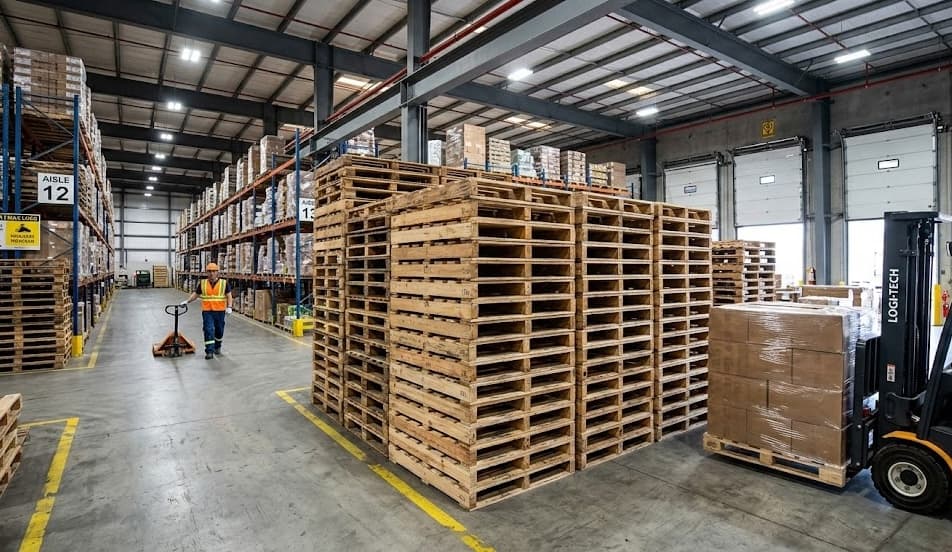
Pallets for Retail & E-Commerce
From warehouse racking to the sales floor, we supply the pallets that keep retail moving — display-ready, lightweight, branded, and optimized for high-volume operations.
Pallets That Work on the Sales Floor
Retail pallets aren't just about moving product — they're part of the shopping experience. A splintered board or protruding nail isn't just a logistics problem; it's a liability and a brand risk. That's why retail buyers demand cleaner grades, tighter tolerances, and consistent quality across every delivery.
E-commerce adds another layer: speed. Fulfillment centers cycle through pallets at rates that make cost-per-trip the most important metric. We help retailers and e-commerce operations find the right balance between quality, cost, and sustainability.
Retail by the Numbers
Retail Pallet Solutions
Retail Display Pallets
Floor-ready pallets designed to go straight from the truck to the sales floor. Clean, sanded surfaces with no protruding nails or rough edges — safe for customer environments and compatible with standard retail aisle widths.
Popular: 48x40 Grade A, sanded & inspected
Half-Pallets for In-Store Merchandising
40x24 and 48x20 half-pallets are the backbone of club-store and big-box merchandising. They fit end-cap displays, center-aisle islands, and seasonal setups. We stock them year-round and can scale for holiday surges.
Ideal for Costco, Walmart, Home Depot displays
Lightweight E-Commerce Pallets
E-commerce fulfillment centers move fast and ship light. Our lightweight pallets reduce freight costs without sacrificing structural integrity. Perfect for parcel-weight loads heading into last-mile carrier networks.
30-35 lbs vs. 50+ lbs standard — real freight savings
Branded & Printed Pallets
Turn your pallet into a brand touchpoint. We offer heat-branded logos, painted decks in custom colors, and stenciled messaging. Great for direct-store delivery, trade show booths, and retail pop-ups where your pallet is visible to the consumer.
Logo branding available on orders of 200+
Pallet Collars for POP Displays
Stackable wooden collars transform a standard pallet into a point-of-purchase bin. Hinged corners fold flat for return shipping. Multiple tiers create eye-level product visibility. We supply collars in standard and custom sizes.
Reusable — each collar lasts 8-10 cycles
Recyclable & Returnable Options
Retail sustainability mandates are tightening. Our recycled-wood pallets and returnable pallet programs help retailers meet corporate green commitments while reducing per-trip costs. We provide documentation for ESG reporting.
Closed-loop programs available for 500+ units/month
Recommended Products for Retail
The most popular pallet configurations our retail clients order.
| Product | Primary Use | Load Capacity | Best For |
|---|---|---|---|
| 48x40 GMA — Grade A | Racking, display, premium retail | 4,600 lbs static | Grocery chains, club stores |
| 48x40 GMA — Grade B | Warehouse, back-of-store, shipping | 4,000 lbs static | E-commerce fulfillment, distribution |
| 40x24 Half-Pallet | End-cap displays, island merchandising | 2,000 lbs static | Big-box retail, seasonal promos |
| 48x40 Lightweight | Parcel shipping, air freight | 2,500 lbs static | E-commerce, DTC brands |
| Custom Branded Pallet | Trade shows, DSD, pop-ups | Varies by build | Brand-forward retailers, CPG companies |
| Pallet Collar Set | POP bins, product dumps | N/A — accessory | Seasonal retail, event merchandising |
High-Volume Cost Optimization
Retail operations run on margins. Our volume programs are designed to bring your per-pallet cost down without compromising quality.
Volume pricing with 5–10% per-unit discount. Dedicated account manager. Priority scheduling on all deliveries.
Tiered pricing structure. Scheduled recurring deliveries (weekly or bi-weekly). Custom grading criteria matched to your specs.
Enterprise pricing. On-site pallet management available. Dedicated inventory reserve. Quarterly business reviews with optimization recommendations.
Already Working with a Pallet Supplier?
We regularly win business from national suppliers by offering faster turnaround, more consistent grading, and a local team that responds the same day. Request a competitive quote — many retail buyers are surprised by the savings.
Get a Competitive QuoteRetail Display Pallet Standards & Requirements
Retail display pallets operate in a fundamentally different environment than warehouse pallets. They are visible to consumers, handled by store associates (not warehouse professionals), and must meet safety, aesthetic, and dimensional standards that vary by retail chain. Understanding these standards is critical for CPG brands, distributors, and manufacturers shipping store-ready loads.
Major Retailer Pallet Specifications
Every major retail chain has specific pallet requirements for inbound shipments. Non-compliant pallets are rejected at the distribution center, resulting in chargebacks, delayed deliveries, and damaged supplier scorecards. Here are the specifications for the most common retail chains our clients ship to.
Walmart / Sam's Club
GMA 48x40 four-way entry. Grade A or B condition. No broken boards, no protruding nails. CHEP blue or PECO red pooling pallets accepted. White wood (non-recycled) preferred for grocery DSD.
Costco
48x40 GMA standard. Requires consistent quality — Costco rejects entire loads for a single non-conforming pallet. Half-pallets (48x20) for club-store display programs. Heat-treated pallets required for imported goods.
Target
48x40 GMA stringer or block. Grade A condition for store-delivery pallets. Target's distribution centers use automated sortation that requires tight dimensional tolerance (+/- 1/4 inch).
Home Depot / Lowe's
48x40 standard for most products. Oversized pallets (48x48, 60x48) accepted for building materials. Higher load capacity required — building materials pallets often exceed 3,000 lbs. Grade B acceptable for warehouse distribution.
Amazon FBA / FBM
40x48 or 48x40 GMA (Amazon accepts both orientations). Four-way entry required. No block pallets. No pallets exceeding 50 inches on any side. Must be able to support the entire load without deflection. Condition: no broken or missing boards.
Store-Ready Pallet Requirements
Store-ready pallets (also called floor-ready or retail-ready pallets) are designed to go directly from the delivery truck to the sales floor without repalletizing. This reduces labor costs for retailers and speeds product-to-shelf time — but it places higher quality demands on the pallet.
Surface Quality
Top deck must be sanded smooth with no splinters, rough edges, or raised grain that could snag product packaging or injure store associates and customers. All nail heads must be flush or countersunk.
Visual Appearance
No excessive staining, mold marks, or dirt. For premium retail environments, some chains require clean or light-colored wood. Branded pallets with retailer logos or product branding are increasingly popular.
Dimensional Consistency
Floor-ready pallets must fit standard retail aisle widths (typically 40-48 inches) and store floor layouts. Half-pallets (40x24 or 48x20) are the standard for end-cap and island displays where full pallets obstruct foot traffic.
Safety Standards
No protruding nails or staples that could catch on clothing, skin, or product packaging. No broken boards that could collapse under product weight. No sharp edges on board ends. OSHA considers these hazards in any workplace — including retail stores.
Load Stability
Store-ready pallets must maintain load stability during transport AND during floor display. Board gaps must be small enough that products do not shift or fall through. Top deck coverage should be 85-100% for display applications.
Ease of Handling
Store associates use manual pallet jacks, not forklifts. Pallets must have smooth, unobstructed fork entry on at least two sides. Block pallets with four-way entry are preferred for retail floor placement where approach angle may be limited.
Seasonal Demand Planning & Reverse Logistics
Retail pallet demand is not constant. Holiday seasons, promotional events, and product launches create demand spikes that can overwhelm unprepared pallet suppliers. Equally important is reverse logistics — getting pallets back from stores and into the recycling or reuse stream to control costs.
Retail Pallet Demand Calendar
Understanding the retail pallet demand cycle helps you secure supply before prices spike and availability tightens. Here is how pallet demand typically flows across the retail year.
January - February
Low-ModeratePost-holiday inventory clearance. Good time to negotiate annual contracts. Pallet supply is abundant, prices are at annual lows. Smart retailers lock in Q2-Q4 pricing now.
March - May
ModerateSpring seasonal products ramp up. Garden centers, outdoor living, and spring merchandise start flowing. Home improvement retailers see significant volume increase. Half-pallet demand rises for seasonal displays.
June - August
Moderate-HighBack-to-school shipping begins in late June. Beverage distribution hits annual peak. Construction materials at peak volume. Pallet recycling supply drops as fewer pallets are returned during summer vacation periods.
September - October
HighHoliday inventory build begins. Retailers start stockpiling for Black Friday and Christmas. Pallet demand surges 30-50% above baseline. Supply tightens and prices begin to rise. This is when unprepared buyers get caught short.
November - December
PeakMaximum demand. Black Friday, Cyber Monday, and Christmas shipping create the highest pallet consumption of the year. Prices peak. Availability is constrained. E-commerce fulfillment centers may consume 200-300% of their normal monthly volume. Only buyers with pre-arranged contracts are guaranteed supply.
Reverse Logistics & Pallet Recovery
Reverse logistics — the process of recovering pallets from retail stores and distribution centers after use — is one of the most overlooked opportunities for retail cost savings. Every pallet that is recovered, repaired, and reused instead of replaced saves $5-$15 per cycle.
Store Pallet Buyback
We purchase used pallets directly from retail stores and distribution centers. Our trucks pick up pallets on a scheduled basis (weekly or bi-weekly) and pay a per-pallet price based on condition. Grade A pallets in good condition fetch $3-$5 each. This turns a disposal cost into revenue for retailers.
Revenue of $3-$5/pallet vs. $25-$50/haul disposal cost
Pallet Exchange Program
For retailers receiving our pallets as part of a managed program, we offer a one-for-one exchange: we deliver fresh pallets and pick up the same number of used pallets. The used pallets are sorted at our yard — repairable pallets go through our repair line, damaged pallets are recycled into mulch or biomass fuel.
30-40% reduction in per-pallet cost vs. new purchase
On-Site Sorting & Grading
For large retail distribution centers generating 500+ pallets per week, we can provide on-site sorting services. Our team grades pallets at your facility, separating Grade A (reusable as-is), Grade B (repairable), and scrap. This eliminates your internal labor for pallet management and ensures maximum recovery value.
Eliminates internal pallet management labor cost
Closed-Loop Retail Pooling
The most cost-effective model for retailers with private-label or DSD programs. We supply pallets to your suppliers, who ship product to your stores on our pallets. Our trucks collect the empty pallets from stores during regular delivery routes. Pallets are returned to our yard, inspected, repaired if needed, and re-circulated.
40-60% total pallet cost reduction vs. one-way purchase
Retail Pallet Cost-Per-Unit Analysis
In retail, the relevant metric is not the price of the pallet — it is the cost per unit of product shipped. A $6 reconditioned pallet carrying 60 cases costs $0.10 per case. A $18 new pallet carrying the same 60 cases costs $0.30 per case. But if the $6 pallet damages 3 cases ($15 total), the true cost per case is $0.35. The right pallet is the one that minimizes total cost per unit delivered.
| Pallet Type | Unit Cost | Avg Trips | Cost Per Trip | Cases/Pallet | Cost Per Case | Damage Rate | True Cost/Case |
|---|---|---|---|---|---|---|---|
| New GMA (Grade A) | $18 | 20 | $0.90 | 60 | $0.015 | 0.2% | $0.018 |
| Reconditioned (Grade A) | $10 | 12 | $0.83 | 60 | $0.014 | 0.5% | $0.019 |
| Reconditioned (Grade B) | $6 | 8 | $0.75 | 60 | $0.013 | 1.5% | $0.028 |
| Economy / #2 | $4 | 3 | $1.33 | 55 | $0.024 | 3.0% | $0.054 |
| Plastic (Rackable) | $48 | 100 | $0.48 | 60 | $0.008 | 0.1% | $0.009 |
| Half-Pallet (Display) | $8 | 5 | $1.60 | 24 | $0.067 | 0.5% | $0.072 |
* True cost per case includes pallet cost per trip plus estimated product damage cost per case. Damage rates are industry averages based on pallet grade. Actual rates vary by product type, handling environment, and transit conditions.
When to Buy New Pallets
New pallets are the right choice when you need maximum consistency, when your retail customer requires them (some chains specify new pallets for DSD programs), when pallets will be visible to consumers on the sales floor, or when you are shipping fragile products where the 0.2% damage rate of new pallets vs. 1.5% for Grade B creates meaningful cost savings. The higher unit cost is often offset by lower damage and longer lifecycle.
When to Buy Reconditioned
Reconditioned Grade A pallets are the sweet spot for most retail distribution. They offer 85-90% of the performance of new pallets at 50-60% of the cost. Grade B reconditioned pallets are ideal for warehouse-to-warehouse shipments where appearance does not matter and damage rates are acceptable. For operations consuming 1,000+ pallets per month, the savings from reconditioned pallets can exceed $10,000/month vs. new.
When to Use Plastic Pallets
Plastic pallets have the highest unit cost but the lowest cost-per-trip for high-cycle closed-loop operations. If your pallets make 50+ trips per year in a controlled retail distribution network (your DC to your stores), plastic pallets will be cheaper than any wood option within 12-18 months. They also eliminate splinter risk, are fully washable, and project a premium brand image on the sales floor.
Retail Chain Requirements & Chargeback Prevention
Retail chargebacks for non-compliant pallets cost suppliers millions of dollars annually. Understanding and meeting each retailer's specific pallet requirements is essential for maintaining positive supplier scorecards and avoiding per-occurrence penalties that typically range from $100 to $500 per incident.
Common Chargeback Triggers
These are the most common pallet-related reasons for load rejection and chargebacks at major retail distribution centers. Avoiding these issues saves thousands of dollars per month for high-volume shippers.
Non-Standard Dimensions
$150 - $300 per occurrencePallets that do not meet the retailer's specified dimensions (typically GMA 48x40) are rejected at the dock. This includes pallets that are technically 48x40 but have warped or twisted profiles that prevent stable stacking.
Broken or Missing Boards
$100 - $250 per occurrenceAny pallet with cracked, broken, or missing top or bottom deck boards is rejected. Retailers consider this both a safety hazard and a product damage risk. Even a single broken board on one pallet can trigger rejection of the entire load.
Protruding Nails / Fasteners
$200 - $500 per occurrenceProtruding nails are classified as a safety hazard. Many retailers have zero-tolerance policies. Chargebacks for protruding nails are among the highest because of liability exposure. Some chains will suspend a supplier after 3 occurrences.
Mold / Contamination
$250 - $500+ per occurrenceVisible mold on pallets carrying food or consumer products is an automatic rejection. For food-grade shipments, mold triggers a food safety investigation that can halt all deliveries from the supplier until the issue is resolved.
Incorrect Pallet Type
$100 - $200 per occurrenceSending block pallets when stringer pallets are specified (or vice versa), using pallets of the wrong grade, or sending heat-treated pallets without proper HT stamps for international shipments. Specification errors are preventable with proper supplier communication.
Our Chargeback Prevention Guarantee
We understand that pallet chargebacks are not just a cost — they damage your relationship with retail buyers and can affect future order volumes. Our quality processes are specifically designed to prevent the issues that trigger chargebacks.
Pre-Delivery Inspection
Every pallet is inspected before loading onto our delivery trucks. We check dimensions (go/no-go gauge), board integrity (visual and tactile), fastener condition (magnetic wand for protruding nails), and cleanliness (mold, staining, odor). Pallets that do not pass are pulled from the order.
Retailer-Specific Grading
We maintain grading profiles for each major retailer in our system. When you tell us the pallet is going to Costco vs. Walmart vs. Amazon, we apply the appropriate grading criteria. This prevents specification mismatches that cause rejections.
Load Photography
We photograph every load before it leaves our yard. If a chargeback is disputed, we have documentation showing the condition of pallets at time of shipment. This has helped our clients successfully dispute hundreds of chargebacks.
Replacement Guarantee
If a pallet we supplied causes a chargeback due to a quality issue that should have been caught in our inspection process, we will replace the pallet at no charge AND reimburse the chargeback amount. This guarantee is included in all our managed pallet programs.
Supplier Scorecard Consulting
We help suppliers understand and improve their pallet-related metrics on retail supplier scorecards. If your on-time-in-full (OTIF) score is being dragged down by pallet issues, we will analyze the root causes and implement corrective actions.
E-Commerce Fulfillment Pallet Solutions
E-commerce fulfillment centers operate at a pace and scale that creates unique pallet requirements. Speed, cost efficiency, automation compatibility, and compliance with marketplace inbound standards are the driving factors.
Amazon FBA Pallet Requirements
Amazon Fulfillment by Amazon (FBA) has specific pallet requirements for inbound shipments to their fulfillment centers. Pallets must be GMA standard (40x48 or 48x40), wood only (no plastic except by prior arrangement), four-way stringer entry (no block pallets), in good condition with no broken boards or protruding hardware. Maximum pallet height including product is 72 inches (50 inches for certain FCs). Maximum pallet weight is 1,500 lbs for standard shipments. Non-compliant pallets are rejected and chargebacked to the seller.
Walmart Marketplace / WFS
Walmart Fulfillment Services (WFS) and marketplace sellers shipping to Walmart DCs must use 48x40 GMA pallets in good condition. Walmart's OTIF (On Time In Full) program includes pallet quality as a scoring metric. Pallets must be shrink-wrapped with product not overhanging the pallet edge. Maximum pallet height is 60 inches including the pallet. Single-SKU pallets are preferred for automated receiving.
Lightweight Pallets for DIM Weight
Many e-commerce shipments are charged by dimensional weight rather than actual weight. A standard 50-lb pallet adds significant DIM weight to every shipment. Our lightweight pallets (30-35 lbs) save approximately $2-4 per LTL shipment in freight costs. For high-volume e-commerce operations shipping 500+ pallets per month, the annual savings can exceed $20,000.
Automation-Compatible Pallets
Modern e-commerce fulfillment centers use automated conveyor systems, robotic palletizers, and ASRS (automated storage and retrieval systems). These systems require pallets with tight dimensional tolerances (+/- 1/4 inch), consistent weight, smooth bottom boards with no protruding fasteners, and predictable fork pocket dimensions. We supply automation-grade pallets pre-measured to your system specifications.
Seasonal Scaling for E-Commerce
E-commerce pallet demand spikes 200-300% during Q4 holiday season (Prime Day, Black Friday, Cyber Monday, Christmas). Fulfillment centers that wait until October to source holiday pallets pay premium prices and face availability constraints. We offer pre-season reservation programs where you lock in pricing and quantity commitments for Q4 delivery, guaranteeing supply at Q2 prices.
Returns Processing Pallets
E-commerce return rates average 20-30%, creating a massive reverse logistics challenge. Returns processing facilities need low-cost pallets for sorting, staging, and re-shipping returned products. Economy Grade B and Grade C pallets are ideal for returns operations where appearance does not matter and pallets cycle through quickly. We supply returns-grade pallets at $4-6 per unit.
Retail Pallet Program Setup — Free Consultation
Whether you are a CPG brand shipping to major retailers, an e-commerce seller fulfilling through Amazon FBA, or a regional retailer managing your own distribution, we can design a pallet program that reduces your per-unit cost, eliminates chargebacks, and scales with your seasonal demand. Our retail team has direct experience with the pallet requirements of every major retail chain in the United States. Schedule a free consultation.
Frequently Asked Questions
Do you stock pallets that meet major retailer specifications?
Yes. We stock pallets meeting Costco, Walmart, Amazon, and other major retailer inbound specifications. Using the correct pallet prevents dock rejections that cost you freight charges and delivery delays.
Can you supply half-pallets for retail floor displays?
Yes. We build and stock half-pallets and quarter-pallets designed to go straight from the truck to the sales floor. Clean, sanded surfaces with no protruding nails, compatible with standard retail aisle widths.
Do you offer high-volume seasonal pallet supply?
Yes. We maintain deep inventory buffers and surge capacity for Q4 holiday season and other peak periods. Standing order clients receive guaranteed allocation and priority scheduling during high-demand months.
What pallet sizes work best for e-commerce fulfillment?
Standard GMA 48x40 pallets work for most fulfillment operations. For smaller packages, we offer half-pallets and custom sizes optimized for automated conveyor and sortation systems common in e-commerce warehouses.
Do you provide branded pallets for retail environments?
Yes. We offer custom painted, stained, and branded pallets for retail displays, trade shows, and customer-facing environments. Branded pallets turn your shipping platform into a marketing asset.
Get Started with Retail Pallets
Tell us about your retail operation and we'll recommend the right pallet program.