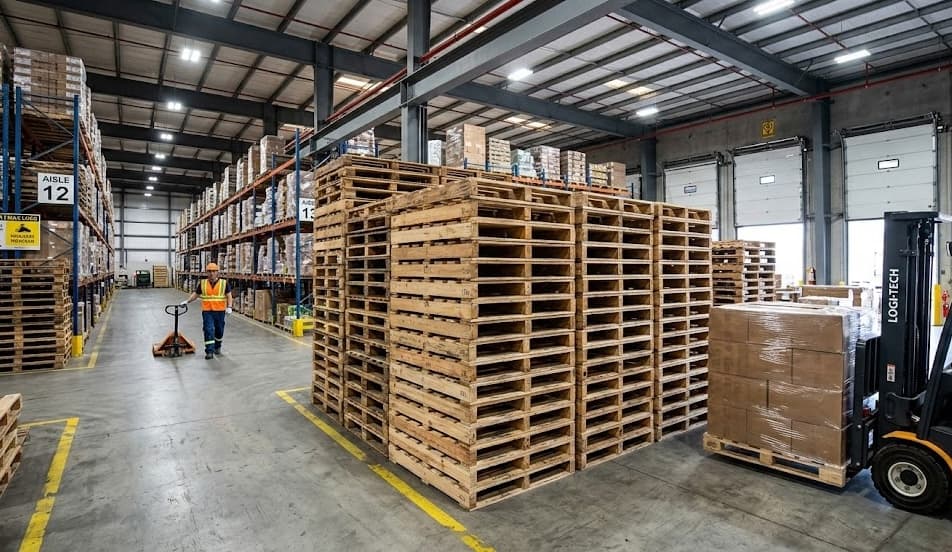
Premium Used Pallets — Proven Quality
We don't just resell pallets. We grade, inspect, and stand behind every single one. Used doesn't mean unreliable — it means smart.
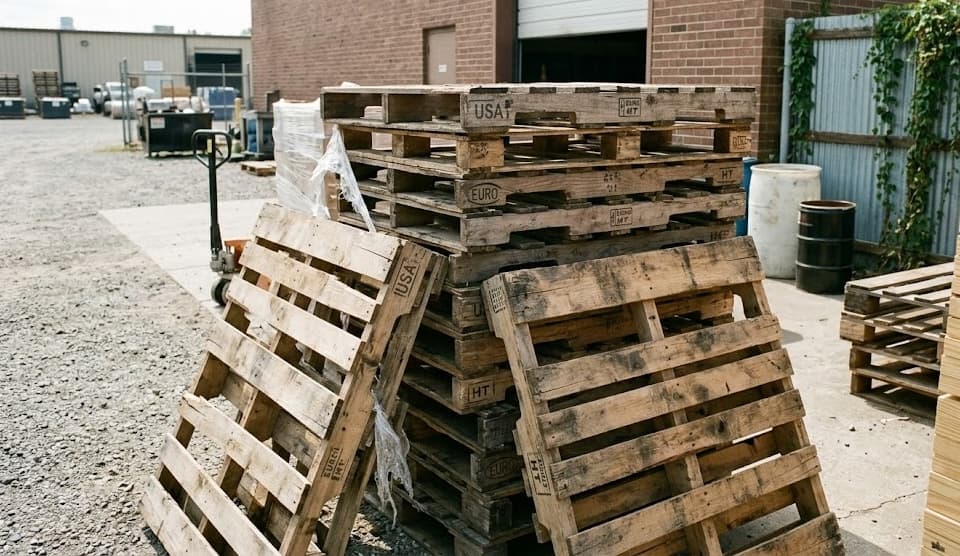
Three grades. One decision.
Grade A — Premium Used
Like-new condition. Minor cosmetic marks only. All structural components intact. Board thickness uniform. Ideal for any application.
- No broken boards
- No missing blocks
- No off-center boards
- < 3 cosmetic marks
Grade B — Standard Used
Light repair may have been done. Structurally sound for normal loads. Minor board replacements acceptable. Most common pallet grade.
- Max 2 repaired boards
- Minor notch repairs OK
- Fully functional
- Great value grade
Grade C — Economy Used
Heavy use, visible repairs, may have some board replacements. Suitable for low-load or one-way applications. Best price per unit.
- Multiple repairs
- Suitable for light loads
- 1–2 use applications
- Bulk & sticker stock
Common Sizes In Stock
Don't see your size? Check our full size guide or request a custom order.
Every used pallet is an eco-win
Manufacturing a new pallet consumes 22–30 lbs of lumber and releases 22 lbs of CO₂. Every used pallet you buy instead saves that resource. Multiply that by your order volume — and you're making a real difference.
What Each Grade Really Means
"Used" is not a single category — it's a spectrum. Our grading system uses 12 structural and cosmetic criteria to assign every pallet a precise quality level. Here is exactly what passes and what fails at each grade.
Grade A — Premium Used
The highest-quality used pallet available. Functionally equivalent to new.
Must Pass
- All deck boards intact — zero missing boards on top or bottom deck
- No broken or cracked boards — hairline surface checks under 4 inches are permissible
- All stringers or blocks fully intact — no structural splits or compression damage
- No board replacements visible — if repaired, the repair is indistinguishable from original
- Fork entry clearance measures 3.5 inches minimum on all designated entry points
- All fasteners flush — no protruding nails, screws, or staples
- Maximum 3 cosmetic marks (scuffs, stains, minor discoloration) on the entire pallet
- Dimensional tolerance within plus or minus 1/4 inch of stated size
- Moisture content below 19% (below 12% for heat-treated inventory)
- No contamination — no chemical stains, oil residue, mold, pest evidence, or odor
Automatic Disqualifiers
- xAny missing deck board (top or bottom)
- xAny stringer with visible split extending more than 50% of its length
- xMore than 3 cosmetic marks on total surface area
- xEvidence of prior repair with mismatched lumber species or thickness
- xAny protruding fastener that cannot be set flush
- xMoisture content above 19%
- xAny evidence of mold, insect activity, or chemical contamination
Pro tip: Grade A pallets are ideal for racking applications, automated warehouse systems, and any environment where consistent dimensions and appearance matter. They typically complete 3-5 additional trip cycles before requiring repair.
Grade B — Standard Used
The industry workhorse. Minor repairs done, structurally sound, great value.
Acceptable Conditions
- Up to 2 deck boards replaced with matching-thickness lumber (species match not required)
- Minor stringer notch repairs permitted — companion board reinforcement acceptable
- Light surface weathering, discoloration, and shipping marks are normal
- Up to 2 lead board edge chips not exceeding 2 inches in length
- Fork entry openings may show minor wear marks but must maintain 3.25 inch minimum clearance
- All boards must be securely fastened — re-nailing with ring-shank nails is standard
- Dimensional tolerance within plus or minus 3/8 inch of stated size
- Moisture content below 22% for standard use
Automatic Disqualifiers
- xMore than 2 replaced deck boards on a single pallet
- xAny stringer broken through its full cross-section
- xMissing blocks on block-style pallets
- xFork entry clearance below 3.25 inches
- xVisible mold covering more than 10% of surface area
- xStructural sag or twist exceeding 1/2 inch when placed on flat surface
Pro tip: Grade B is the most commonly purchased grade in the industry. It offers the best cost-to-performance ratio for general warehousing, domestic shipping, and floor-stacking applications. Expect 1-3 additional trip cycles.
Grade C — Economy Used
Maximum savings for light-duty and one-way applications.
Acceptable Conditions
- Up to 4 deck boards replaced — mixed lumber species and minor thickness variation acceptable
- Multiple stringer repairs including companion boards and reinforcement plates
- Heavy weathering, significant discoloration, and multiple shipping marks
- Lead board edge damage up to 4 inches permitted if structurally stable
- Visible board gaps up to 3.5 inches between deck boards
- Fork entry may show significant wear — minimum 3 inch clearance required
- Dimensional tolerance within plus or minus 1/2 inch of stated size
- Pallets may show twist or bow up to 3/4 inch
Automatic Disqualifiers
- xMore than 4 replaced boards on a single pallet
- xAny stringer or block that cannot support minimum rated load
- xStructural failure visible under 1,000 lb static test load
- xActive mold growth or visible insect infestation
- xChemical contamination or strong residual odors
- xMissing bottom deck boards that prevent stacking stability
Pro tip: Grade C pallets are the go-to choice for one-way outbound shipments, construction site material staging, and temporary storage applications. At $1-$3 per unit, they deliver unbeatable per-trip economics when you don't need the pallet back.
Load Capacity by Grade & Size
Understanding the three types of pallet load capacity is critical for safe handling and storage. Dynamic load is weight during transport, static load is weight at rest, and racking load is weight when supported only at the edges on warehouse racking.
| Pallet Configuration | Grade A | Grade B | Grade C |
|---|---|---|---|
| 48x40 Stringer — Dynamic Load | 2,500 lbs | 2,200 lbs | 1,500 lbs |
| 48x40 Stringer — Static Load | 2,800 lbs | 2,500 lbs | 1,800 lbs |
| 48x40 Stringer — Racking Load | 1,800 lbs | 1,400 lbs | Not recommended |
| 48x40 Block — Dynamic Load | 2,800 lbs | 2,500 lbs | 1,800 lbs |
| 48x40 Block — Static Load | 3,200 lbs | 2,800 lbs | 2,000 lbs |
| 48x40 Block — Racking Load | 2,200 lbs | 1,800 lbs | Not recommended |
| 42x42 Stringer — Dynamic Load | 2,200 lbs | 2,000 lbs | 1,400 lbs |
| 48x48 Stringer — Dynamic Load | 2,400 lbs | 2,100 lbs | 1,500 lbs |
| 40x40 Stringer — Dynamic Load | 2,000 lbs | 1,800 lbs | 1,200 lbs |
Important Safety Note
Load ratings are based on uniformly distributed loads on a full deck surface. Point loads, off-center loads, and top-heavy loads reduce effective capacity by 20-40%. When in doubt, use the next grade up or contact our team for a load-specific recommendation. We also offer on-site load testing for enterprise customers at no additional charge.
Which Grade Fits Your Industry?
Different industries have different requirements for pallet condition, compliance, and performance. Here is how our grades map to the most common applications in the San Diego area.
- Food & Beverage Distribution
Clean appearance, no contamination risk, consistent dimensions for automated conveyors. Required by most major grocery chains.
- Pharmaceutical Warehousing
FDA-adjacent environments demand pallets free of mold, chemical residue, and pest evidence. Grade A meets GMP facility standards.
- Retail Display & Showrooms
Customer-facing environments where pallet appearance impacts brand perception. Grade A pallets present professionally.
- Automated Warehouse Systems
AS/RS systems and robotic pallet movers require tight dimensional tolerances. Grade A's plus-minus 1/4 inch spec ensures compatibility.
- Cold Storage & Refrigeration
Controlled-moisture Grade A pallets resist warping in temperature-cycling environments better than lower grades.
- General Warehousing
The standard choice for in-facility storage, order picking, and staging. Handles normal warehouse loads with no issues.
- Domestic LTL Shipping
For palletized LTL shipments that travel by truck within the continental US, Grade B provides reliable performance at half the cost of new.
- Manufacturing Floor Use
Work-in-progress staging, raw material storage, and inter-facility transfers. Grade B handles repeated forklift cycling.
- E-Commerce Fulfillment
Third-party logistics and fulfillment centers processing high volumes find Grade B delivers the best cost-per-shipment.
- Agriculture & Nursery
Outdoor use, exposure to soil and water. Grade B pallets handle the conditions while keeping costs manageable.
- One-Way Outbound Shipping
When the pallet leaves your facility and doesn't come back, Grade C minimizes cost. You're paying for one trip — nothing more.
- Construction & Jobsite Use
Stacking bricks, lumber, tile, and building materials on uneven ground. Grade C handles rough terrain at the lowest cost.
- Recycling & Waste Transfer
Pallets used in recycling operations, transfer stations, and waste processing where cosmetic quality is irrelevant.
- Temporary Event Staging
Festivals, pop-up markets, and outdoor events that need cheap, disposable pallets for one-time use.
- Export (Non-ISPM Countries)
Shipments to countries that don't require ISPM 15 compliance can save significantly with Grade C one-way pallets.
Pallet Storage Best Practices
Proper storage extends pallet lifespan by 30-50% and prevents safety hazards. Follow these guidelines to get the most value from your used pallet investment.
Stack Height Limits
OSHA and NFPA guidelines recommend a maximum stack height of 15 feet for empty pallets, which is approximately 20-25 pallets depending on pallet height. Indoor stacks should be limited to 6 feet (8-10 pallets) near sprinkler heads. Always stack on level, hard-surface flooring — never on gravel, dirt, or uneven surfaces that cause bottom pallets to shift.
Indoor vs. Outdoor Storage
Indoor storage is always preferred. Pallets stored outdoors deteriorate 3-4 times faster due to UV exposure, rain saturation, and temperature cycling. If outdoor storage is necessary, cover stacks with waterproof tarps and elevate the bottom pallet on concrete blocks to prevent ground moisture wicking. Rotate outdoor stock within 30 days to minimize weathering.
Moisture & Ventilation
Store pallets in well-ventilated areas with ambient humidity below 60%. Pallets absorb moisture from concrete floors — place a vapor barrier or slip sheet under the bottom pallet in humid climates. Wet pallets should be air-dried before stacking to prevent mold growth. Never shrink-wrap a stack of wet pallets; trapped moisture accelerates decay.
Fire Safety Compliance
Empty pallet storage is classified as high-hazard by NFPA. Maintain minimum 8-foot clearance between pallet stacks and walls. Keep 25-foot clearance from building exits. Install early-suppression fast-response (ESFR) sprinklers over pallet storage areas. Limit individual stack footprint to 400 square feet maximum. Post 'No Smoking' signage in all pallet storage zones.
Pest Prevention
Wood pallets can harbor insects, particularly bark beetles and termites. Inspect incoming pallets for bore holes, sawdust trails, and live insects. Heat-treated (HT) pallets have been raised to a core temperature of 132.8 degrees F for 30 minutes, eliminating most pests. For long-term storage, consider treating stored pallets with borate-based preservatives.
Inventory Rotation (FIFO)
Practice first-in, first-out rotation for your pallet inventory. Pallets stored more than 6 months begin to deteriorate even in ideal conditions — wood dries, joints loosen, and boards warp. Mark delivery dates on each stack and use oldest stock first. Our regular delivery customers receive pre-marked pallets to simplify FIFO tracking.
Ordering Process — From Quote to Delivery
We've streamlined our ordering process so you can go from first contact to pallets on your dock in as little as 24 hours. Here is exactly what to expect at every step.
Request a Quote
Email us or fill out the form below. Tell us the grade, size, quantity, and delivery zip code. We respond within 2 hours during business hours.
Receive Your Quote
We provide an itemized quote including per-pallet pricing, delivery fee (if applicable), and estimated delivery date. Quotes are valid for 7 days. Volume discounts are applied automatically.
Confirm & Schedule
Approve the quote by email. We schedule delivery based on your preferred date and time window. Same-day delivery available for in-stock items ordered before 10 AM.
Quality Check & Load
Our team pulls your order from graded inventory, performs a final quality spot-check, and loads the pallets onto our flatbed truck. We photograph every load for your records.
Delivery & Unload
Our driver delivers to your dock, forklift-accessible location, or ground-level drop. You verify count and condition on-site. Any issues are resolved immediately or credited same day.
Same-day delivery for in-stock grades and sizes ordered before 10 AM within San Diego County.
All quote requests receive a response within 2 business hours. Most are answered within 30 minutes.
If any pallet doesn't meet its stated grade, we replace it immediately at no cost — no questions, no hassle.
Frequently Asked Questions
What is the difference between Grade A, B, and C pallets?
Grade A is premium used — like-new condition with no broken boards, suitable for any application. Grade B is standard used — structurally sound with minor cosmetic wear, ideal for warehousing. Grade C is economy — functional for light-duty, one-way, or dunnage use.
How much do used pallets cost?
Grade A pallets cost $8-12 each, Grade B costs $5-8, and Grade C costs $1-4 per pallet. Volume discounts apply automatically at 100+ units. Pricing varies by size and current market conditions.
Are used pallets strong enough for heavy loads?
Yes. Grade A used pallets are rated for 2,500 lbs dynamic load, Grade B for 2,000+ lbs, and even Grade C handles 1,000+ lbs. For heavier applications, we offer hardwood and heavy-duty options rated to 5,000+ lbs.
Do you inspect used pallets before selling?
Every used pallet is individually inspected and graded to NWPCA standards. We check structural integrity, board condition, moisture content, and contamination. Our outbound rejection rate is under 0.5%.
What is the minimum order for used pallets?
Our standard minimum for used pallets is 25 units. For smaller quantities, contact us and we will do our best to accommodate. There is no maximum — we handle orders from 25 units to full truckloads of 400+.
Order Used Pallets
Specify grade, size, and quantity below.