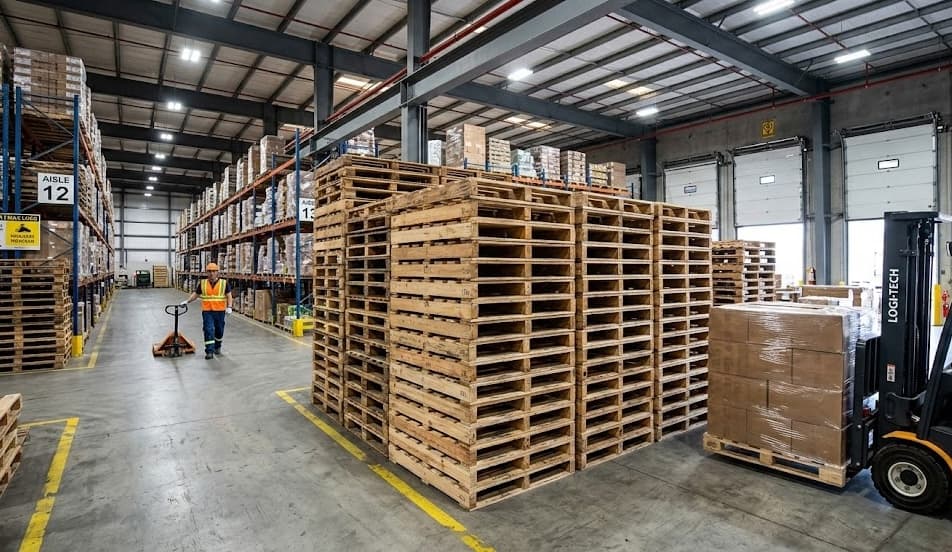
Pallet Consulting That Cuts Costs
Most businesses treat pallets as an afterthought. We help you turn your pallet program into a strategic advantage with real, measurable savings.
Average cost reduction
across our consulting clients
Typical audit timeline
from discovery to report delivery
Client savings documented
in the past 24 months
What We Analyze
Our consulting engagements cover six core areas. Every recommendation comes with projected ROI and a clear implementation path.
Pallet Spend Analysis
We audit your current pallet purchases, repair costs, and disposal fees to find hidden savings. Most businesses overspend by 15-30% without realizing it.
Grade & Size Optimization
Are you buying Grade A when Grade B would work? Using 48x40 when 42x42 fits your product better? We match the right pallet spec to each use case.
Recycling Program Design
We design a closed-loop pallet recycling program tailored to your facility: collection schedules, sorting protocols, and vendor coordination.
Supply Chain Flow Mapping
We trace your pallet journey from inbound receiving to outbound shipping, identifying where pallets are lost, damaged, or sitting idle.
Sustainability & ESG Reporting
Get hard numbers for your sustainability reports: CO2 diverted, wood saved, landfill reduction. Formatted for GRI, CDP, or internal ESG frameworks.
Vendor Consolidation Strategy
If you are buying from multiple pallet vendors, we help you consolidate for better pricing, consistent quality, and simpler logistics.
Our Consulting Process
Discovery Call
30-minute call to understand your operations, pain points, and goals. No commitment required.
On-Site Audit
We visit your facility to inspect pallet inventory, assess damage rates, and observe handling processes.
Data Analysis
We crunch the numbers: current spend, waste rates, grade mismatches, and recycling potential.
Optimization Report
A clear, actionable report with specific recommendations, projected savings, and implementation timeline.
Implementation Support
We help you execute: new vendor setup, recycling program launch, grade switching, and staff training.
Who Benefits Most
- Warehouses using 500+ pallets/month
At this volume, even a $1/pallet saving adds up to thousands per year.
- Companies with high damage rates
If more than 10% of your pallets are being scrapped, there is a process or grade problem.
- Businesses with ESG or sustainability goals
We provide the data and documentation to prove your waste-reduction claims.
- Multi-location operations
Standardizing pallet specs and vendors across sites creates economies of scale.
Sample Client Results
Regional food distributor
Switched from all-new to 70% reconditioned pallets
$84,000/year
E-commerce fulfillment center
Downsized from 48x40 to 40x32 for parcel-only lanes
$31,000/year
Auto parts manufacturer
Implemented buyback program for outbound pallets
$52,000/year
Free Discovery Call
Not sure if consulting is right for you? Start with a free 30-minute discovery call. We will ask about your current pallet operations and give you an honest assessment of whether our consulting engagement would deliver meaningful ROI. No pressure, no obligation.
Data-Driven Consulting Methodology
Our consulting approach is built on observable data, not opinions. Every recommendation we make is backed by numbers from your actual operation, industry benchmarks, and our experience across hundreds of pallet programs in Southern California.
Phase 1: Data Collection
Before we visit your facility, we gather baseline data. We request your last 12 months of pallet purchase invoices, disposal/hauling receipts, and any internal tracking data you have on pallet damage or loss. We also want your product specifications (weights, dimensions, handling requirements) so we can evaluate whether your current pallet specs match your actual needs.
If you do not have this data organized, that is fine. Part of our value is helping you build a pallet tracking system. We start with whatever information is available and supplement it with our on-site observations.
Phase 2: On-Site Audit
Our on-site audit typically takes 4-6 hours for a single-facility operation. We walk your entire workflow from inbound receiving to outbound shipping, documenting every point where pallets are received, stored, loaded, unloaded, damaged, or discarded. We photograph damage patterns, measure pallet dimensions, grade a random sample of your inventory, and interview your warehouse and dock staff.
What we are looking for: grade mismatches (using Grade A where Grade B would work), size mismatches (paying for 48x40 when your product fits on 40x32), handling damage patterns (forklift operators hitting the same spot repeatedly), storage issues (pallets stored outdoors degrading prematurely), and flow inefficiencies (pallets accumulating in areas where they block operations).
Phase 3: Analysis & Modeling
Back at our office, we run the numbers. We build a cost model of your current pallet program: total spend on new pallets, repair costs (internal or external), disposal and hauling fees, transportation costs, labor for pallet handling, and opportunity cost of space used for pallet storage. Then we model alternative scenarios: what if you switched 50% of your purchases to reconditioned? What if you implemented a repair program instead of disposing? What if you downsized your pallet spec?
Each scenario is modeled with conservative, moderate, and optimistic assumptions so you can see the range of potential outcomes. We never present a single number without context.
Phase 4: Recommendations Report
The deliverable is a comprehensive report (typically 15-25 pages) with specific, actionable recommendations. Not vague suggestions like "consider recycling." Instead: "Switch your Zone 3 outbound lanes from new 48x40 Grade A ($14.50/unit) to reconditioned 48x40 Grade B ($7.50/unit), saving $7.00/pallet on approximately 800 pallets/month = $5,600/month or $67,200/year."
Every recommendation includes the implementation steps, timeline, projected savings, potential risks, and our confidence level. We prioritize recommendations by ROI so you can start with the highest-impact changes first.
What We Inspect During an On-Site Audit
Our audit covers every aspect of your pallet program. Here is a detailed breakdown of the 12 areas we evaluate and what we are looking for in each.
Inbound Pallet Receiving
We observe how pallets arrive at your facility. Are they on your suppliers' pallets (which you may be paying for indirectly)? Are inbound pallets inspected for damage? Are you rejecting damaged pallets or absorbing the cost? We count and grade a sample of inbound pallets to establish your incoming quality baseline.
Pallet Storage Areas
Where are empty pallets stored? How much floor space do they consume? Are they stored outdoors where they degrade? We measure the square footage dedicated to pallet storage and calculate its cost based on your per-square-foot facility cost. Often, consolidating pallet storage frees valuable warehouse space.
Loading & Staging Operations
We watch how pallets are loaded and handled. Fork operators turning too tight? Pallets being dropped from height? Improper stacking causing top-pallet damage? We document every handling practice that contributes to damage, because fixing the cause is cheaper than repairing the result.
Damage Rate & Patterns
We grade a statistical sample of your damaged pallets to identify patterns. If 80% of your damage is broken lead deck boards, the cause is likely forklift entry angle. If your stringers are cracking at the notch, the loads may exceed the pallet's rated capacity. Patterns point to root causes.
Pallet Specifications
Are you using the right pallet for your product? We compare your product weight, dimensions, and handling requirements against your current pallet spec. If you are putting 800-pound loads on pallets rated for 2,500 pounds, you are over-specifying and overpaying. We match the right grade and design to each application.
Disposal & Waste Stream
How are pallets leaving your facility? Dumpster? Waste hauler? Left on the dock for someone else to deal with? We quantify the cost of disposal (hauling fees, labor, lost value) and identify which pallets in your waste stream are actually repairable or saleable through a buyback program.
Vendor & Pricing Review
We review your current pallet purchase agreements, pricing, and terms. Are you getting market-rate pricing? Are you locked into a contract that no longer reflects your actual needs? Are you buying from multiple vendors when consolidation would yield better pricing? We benchmark your costs against current market data.
Repair vs. Replace Economics
If you currently dispose of all damaged pallets and buy new, we calculate the cost of implementing a repair program. For most operations using 500+ pallets per month, in-house or outsourced repair saves 40-60% on the damaged portion of your inventory.
Recycling Opportunity
We evaluate whether a managed recycling program would be cost-neutral or cost-positive for your operation. In many cases, the value recovered through buyback and recycling credits exceeds the cost of collection, turning your pallet waste stream into a revenue stream.
Seasonal Demand Patterns
We analyze your order history for seasonal peaks and valleys. If your pallet consumption doubles in Q4, pre-ordering during low-demand months can lock in lower prices. We help you build a purchasing calendar aligned to both your demand and market pricing cycles.
Employee Training Gaps
Warehouse staff often have no training on pallet handling. Simple changes like approach angle for forklift entry, proper stacking heights, and damage identification can reduce your pallet damage rate by 15-25%. We identify training opportunities and can provide on-site instruction.
Sustainability & Reporting
If your organization has sustainability targets, we evaluate your current pallet program against those goals and identify gaps. We build a roadmap to achieve specific waste-reduction, recycling, and carbon-reduction targets with documented metrics for your reporting.
Proven Cost Optimization Strategies
These are the strategies that consistently deliver the biggest savings across our consulting clients. Most companies can implement at least 3 of these immediately.
Grade Optimization
15-35% reduction in pallet purchase costsThe most common finding in our audits: companies buying Grade A pallets for applications where Grade B or even Grade C would perform identically. Grade A costs $12-18 per pallet; Grade B costs $7-10. If your pallets are going into racking where appearance does not matter, or if they are one-way shipments to customers who will not return them, Grade B delivers the same structural performance at a significant discount. We match each of your use cases to the minimum viable grade.
Size Right-Sizing
10-25% reduction in pallet purchase costsThe standard 48x40 GMA pallet is the default for most companies, but it is not always the right choice. If your product fits on a smaller footprint, a 40x32 or 36x36 pallet uses less wood, costs less, and may allow more units per truckload. Conversely, if you are double-stacking 48x40 pallets because your product overhangs the edges, a 48x48 pallet eliminates the overhang and reduces product damage. We model the total cost including pallet price, freight efficiency, and product damage rates.
Repair Program Implementation
40-65% reduction in damaged pallet replacement costsIf you are currently discarding every damaged pallet and buying new, implementing a repair program delivers the fastest ROI of any strategy. We design the program based on your volume: for 200+ damaged pallets per month, outsourced repair to our facility is most efficient. For 500+, on-site repair crews are more cost-effective. For 1,000+, a hybrid model with on-site crews supplemented by our facility for overflow maximizes throughput.
Recycling Revenue Capture
$0.50-$3.00 per pallet recovered vs. $0 (disposal)Every pallet you put in a dumpster costs you twice: the disposal fee and the lost recovery value. A managed recycling program captures the residual value from pallets you no longer need. Reusable pallets are sold back through buyback. Repair stock is recovered and applied to your own repair program. Even end-of-life pallets generate value as mulch and biomass. Net effect: your disposal cost drops to zero and you receive a credit.
Vendor Consolidation
8-15% reduction in total pallet spend through volume leverageCompanies with multiple locations often buy pallets from different local vendors at each site, losing the leverage that consolidated volume provides. We help you consolidate to one or two vendors (we are happy to compete for the business) who can serve all locations with consistent pricing, quality, and service levels. Volume consolidation typically unlocks tier pricing that individual locations cannot access.
Seasonal Purchasing Calendar
5-12% reduction through counter-cyclical buyingPallet prices follow predictable seasonal patterns. Demand peaks in late Q3 and Q4 (back-to-school and holiday shipping), pushing prices up 10-15%. Q1 and early Q2 typically see lower demand and lower prices. If your storage allows, pre-purchasing in low-demand months and building a buffer inventory locks in lower per-unit costs. We build a 12-month purchasing calendar specific to your demand curve and storage capacity.
ROI Calculations: What Consulting Actually Delivers
Our consulting engagement costs money. Here is an honest breakdown of what it costs versus what it typically returns, based on actual client outcomes.
Engagement Costs
Typical Returns (Year 1)
Typical ROI on consulting fees
Based on Year 1 savings versus engagement cost
Average time to positive ROI
Most clients recoup the consulting fee within the first quarter
Clients with positive ROI in Year 1
Every consulting engagement has delivered net savings
Detailed Case Studies
Here are three detailed examples of how our consulting delivered measurable results for real San Diego businesses.
Regional Food Distributor: $84,000/Year Savings
The Problem
A food distribution company with 3 San Diego area warehouses was purchasing 2,400 new Grade A 48x40 pallets per month at $14.50 each. Their annual pallet spend was $417,600. They were disposing of approximately 1,800 used pallets per month at a cost of $3,200/month in hauling fees. No recycling, no repair, no buyback. Total annual pallet program cost: $456,000.
Our Findings
Our audit revealed that 70% of their pallet usage (outbound domestic shipments to retail stores) did not require Grade A. The pallets were loaded onto trucks and never seen again by the distributor. Grade B reconditioned pallets would perform identically for these lanes. Additionally, 65% of their "disposed" pallets were actually Grade B reusable or Grade C repairable.
Implemented Changes & Results
Switched 70% of purchases to Grade B reconditioned at $7.50/unit
Saved $141,120/year
Implemented buyback program for 1,170 reusable pallets/month
Generated $56,160/year revenue
Eliminated hauling fees through recycling program
Saved $38,400/year
E-Commerce Fulfillment Center: $31,000/Year Savings
The Problem
An e-commerce fulfillment center was shipping 3,200 orders per month on standard 48x40 GMA pallets. Their parcel-only lanes (small packages going to parcel carriers) were using full-size pallets that were only 40% loaded, wasting trailer space and pallet cost. Annual pallet spend: $192,000 on new 48x40 pallets at $5.00 per used pallet (they were buying reconditioned already).
Our Findings
45% of their outbound volume (parcel-to-carrier lanes) involved light loads under 500 pounds on 48x40 pallets. A 40x32 half-pallet would fit these loads perfectly, cost $2.50 less per unit, and allow double-stacking in the trailer. We also found they were storing 600+ empty pallets in aisles that could be used for pick locations, constraining their throughput capacity.
Implemented Changes & Results
Switched 45% of volume to 40x32 half-pallets at $2.50/unit
Saved $21,600/year
Implemented weekly pallet pickup to clear storage areas
Recovered 1,200 sq ft floor space
Sold surplus 48x40 pallets through buyback
Generated $9,600/year revenue
Auto Parts Manufacturer: $52,000/Year Savings
The Problem
An automotive parts manufacturer was buying 1,500 new heat-treated pallets per month for international shipments to Mexico at $24 each. Incoming parts from domestic suppliers arrived on untreated pallets that were discarded. The company had no mechanism to capture value from the 1,200+ inbound pallets received monthly. Annual pallet spend: $432,000 on HT pallets plus $18,000 in disposal fees for inbound pallets.
Our Findings
We discovered that 40% of their inbound pallets were already heat-treated (with valid IPPC stamps) but were being discarded because no one was checking. These pallets could be reused for their Mexico shipments after inspection. Additionally, the remaining 60% of inbound pallets were Grade A/B quality that could be sold through buyback. We also identified that their HT pallet vendor was charging a 15% premium over current market pricing.
Implemented Changes & Results
Captured 480 inbound HT pallets/month for reuse (40% of inbound)
Saved $138,240/year in avoided purchases
Buyback program for 720 non-HT inbound pallets/month
Generated $34,560/year revenue
Renegotiated HT pallet pricing with competitive bids
Saved $36,720/year on reduced HT purchases
Frequently Asked Questions
What does your pallet consulting service include?
Our consulting covers pallet spend analysis, grade and size optimization, recycling program design, vendor consolidation, sustainability reporting setup, and ongoing cost monitoring. We tailor the scope to your specific needs.
How much can pallet consulting save my business?
Most businesses discover 15-30% in hidden savings through grade optimization, right-sizing, and recycling program implementation. A mid-size operation cycling 1,000 pallets monthly can typically save $20,000-50,000 annually.
Do you offer free initial assessments?
Yes. We provide a free initial pallet audit for qualified businesses. This includes reviewing your current spend, grading practices, and disposal methods to identify immediate savings opportunities.
Can you help set up a pallet recycling program?
Absolutely. We design complete recycling programs including pickup scheduling, processing logistics, ESG reporting, and cost analysis. We handle implementation from first pickup to first sustainability report.
Do you provide sustainability reporting support?
Yes. We help businesses build pallet-related sustainability documentation including CO2 diversion data, waste reduction metrics, and material recovery rates formatted for GRI, SASB, and CDP reporting frameworks.
Schedule a Consultation
Tell us about your operation and we will reach out within one business day.