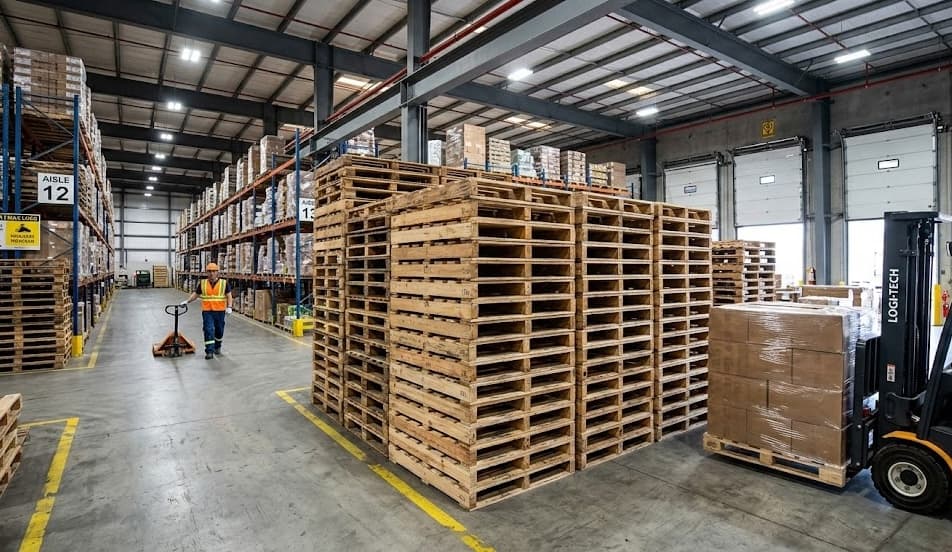
Heavy-Duty Pallets for Heavy-Duty Work
Manufacturing demands pallets that can handle concentrated loads, repeated forklift handling, and the rigors of automated production lines.
Built for the Production Floor
Standard pallets fail on manufacturing floors. Engine blocks, steel components, CNC machines, and heavy assemblies require pallets engineered for concentrated point loads, not just distributed weight.
Our heavy-duty block pallets and custom-engineered platforms are built with thicker deck boards, reinforced stringers, and nine-block construction that distributes weight evenly and allows four-way forklift entry. They are designed to survive the repeated impacts, stacking forces, and rough handling that are standard in manufacturing environments.
For high-volume manufacturing operations, we also offer pallet repair programs that extend the life of your existing inventory by 3-5x, keeping your per-pallet cost as low as possible.
Manufacturing Requirements We Solve
Load Capacity Comparison
| Pallet Type | Static Load | Dynamic Load | Racking Load | Forklift Entry | Price Range |
|---|---|---|---|---|---|
| Standard Stringer (GMA) | 2,500 lbs | 2,200 lbs | Not recommended | 2-way | $8 - $15 |
| Reinforced Stringer | 3,500 lbs | 2,800 lbs | 1,800 lbs | 2-way (notched: 4-way) | $14 - $22 |
| Standard Block Pallet | 4,800 lbs | 2,800 lbs | 2,200 lbs | 4-way | $28 - $40 |
| Heavy-Duty Block Pallet | 6,000 lbs | 3,500 lbs | 2,800 lbs | 4-way | $38 - $55 |
| Plastic (Rackable) | 5,000 lbs | 3,000 lbs | 2,500 lbs | 4-way | $45 - $75 |
| Custom Engineered | 8,000+ lbs | 5,000+ lbs | Custom | 4-way | Call for quote |
* Load ratings are approximate and vary by wood species, moisture content, and construction method. Contact us for certified load testing data.
Manufacturing Sectors We Support
Automotive & Parts
Block pallets for engines, transmissions, and stamped body panels. We supply several Tier 1 and Tier 2 automotive suppliers in the San Diego and Tijuana corridor.
Aerospace & Defense
Custom crating and pallet platforms for sensitive aerospace components. ISPM 15 certified for international defense logistics.
Electronics & Semiconductors
Clean, splinter-free pallets for electronics assembly and semiconductor wafer transport. Plastic and presswood options available.
Metal Fabrication
Heavy-gauge pallets for steel plate, aluminum extrusions, and fabricated metal assemblies. Rated for concentrated point loads.
Machinery & Equipment
Oversized custom pallets and skids for CNC machines, industrial equipment, and heavy tooling. Engineered to specific weight and dimension requirements.
Consumer Goods Production
Standard and reconditioned GMA pallets for consumer product manufacturing. High-volume programs with scheduled weekly deliveries.
High-Volume Repair Program
For manufacturers cycling through 500 or more pallets per month, our repair program is the most cost-effective way to maintain your pallet fleet. Instead of discarding damaged pallets and buying new, we repair them on-site or at our yard for a fraction of the replacement cost.
Our repair crews can work at your facility during off-hours to minimize disruption. We carry inventory of replacement boards, blocks, and fasteners sized specifically for your pallet specs.
Board replacement
vs. $15-$40 new pallet
Block repair/replace
vs. $28-$55 new block pallet
Full recondition to spec
60-80% savings vs. new
On-site repair crew
Zero downtime for your operation
Max static load (lbs)
Standard block pallet
Largest standard size (in)
Custom sizes available beyond
Lifespan extension
Through our repair program
Custom Engineering Available
If your product does not fit a standard pallet, we can engineer a custom solution. We have built pallets and skids for items ranging from 200-lb automotive subassemblies to 8,000-lb industrial generators. Send us your product dimensions and weight and we will design the right platform. View custom pallet options.
Heavy-Duty Pallet Engineering
Manufacturing pallets are not just bigger versions of standard pallets. They are engineered platforms designed to handle concentrated loads, repeated mechanical stress, and the precise dimensional requirements of automated handling systems. Understanding the engineering behind heavy-duty pallets helps you specify the right pallet for your application.
Block vs. Stringer Construction
The fundamental engineering difference in pallet construction is the support system. Stringer pallets use two or three long boards (stringers) running the length of the pallet, while block pallets use nine or more blocks positioned at corners, center points, and midpoints. This distinction has critical implications for manufacturing applications.
Block Pallets — Preferred for Manufacturing
Nine-block construction provides true four-way forklift entry (stringer pallets only allow two-way entry unless notched, which weakens the stringer). Block pallets distribute weight across more support points, reducing deck board deflection under concentrated loads. This makes them the standard for automotive, aerospace, and heavy industrial applications. Static load capacity: 4,800 - 6,000+ lbs.
Reinforced Stringer Pallets — Budget Alternative
For lighter manufacturing loads (under 3,500 lbs), reinforced stringer pallets offer adequate performance at lower cost. Reinforcement includes thicker stringers (typically 1.5 inches vs. standard 1.375 inches), additional deck boards (7-board top deck vs. standard 5-board), and hardwood species selection (oak or maple vs. pine). Notched stringers allow partial four-way entry but reduce stringer strength by approximately 30%.
Wood Species & Structural Performance
Wood species selection directly affects load capacity, durability, weight, and cost. Manufacturing operations handling heavy loads must specify appropriate species, not just rely on generic "wood pallet" descriptions.
| Species | Bending Strength | Stiffness | Weight | Best For |
|---|---|---|---|---|
| Red Oak | Excellent | High | Heavy (55-60 lbs) | Extreme loads, racking |
| Hard Maple | Excellent | Very High | Heavy (58-65 lbs) | Automated systems |
| Southern Yellow Pine | Good | Moderate | Medium (45-50 lbs) | General manufacturing |
| SPF (Spruce/Pine/Fir) | Moderate | Moderate | Light (38-45 lbs) | Light manufacturing |
| Mixed Hardwood | Good-Excellent | High | Heavy (50-60 lbs) | Cost-effective heavy duty |
Bending strength measured per ASTM D143. Stiffness measured as Modulus of Elasticity (MOE). Weight for standard 48x40 GMA configuration.
Deck Board Engineering
Manufacturing pallets require deck boards thick enough to resist concentrated point loads without cracking. Standard deck boards are 5/8 inch thick; heavy-duty applications use 3/4 inch or 1 inch boards. Board width affects load distribution — wider boards (5.5 inches vs. 3.5 inches) spread concentrated loads across more wood fiber. For the highest point-load resistance, specify full-coverage top decks with no gaps between boards.
Fastener Selection & Pattern
The fastener system is the most common failure point in pallet construction. Manufacturing pallets should use spiral-shank or ring-shank nails that resist pull-through under dynamic loads. Standard smooth-shank nails lose 40-60% of their holding power after the first loading cycle. Fastener pattern matters too — heavy-duty pallets use 3 nails per board-to-stringer junction vs. 2 for standard pallets, and block pallets use lag screws or bolts for block-to-deck connections.
Moisture Content Control
Wood moisture content directly affects pallet strength. The National Wooden Pallet & Container Association (NWPCA) recommends maximum 19% moisture content for pallets. At 28% moisture (fiber saturation point), wood loses approximately 50% of its bending strength compared to 12% moisture. Manufacturing pallets handling heavy loads should specify kiln-dried or heat-treated wood at 12-15% moisture for maximum structural performance.
Load Testing Standards & Certification
Manufacturing operations cannot afford pallet failures. Load testing per ASTM and ISO standards provides documented assurance that your pallets will perform under the specific loading conditions in your facility.
ASTM D1185 — Standard Test Methods
ASTM D1185 is the primary US standard for testing pallet performance. It defines test methods for measuring the structural capacity of pallets under various loading conditions that directly correspond to real-world manufacturing scenarios.
Static Compression Test
Measures maximum load a pallet can support when stacked in a stationary position. Load is applied uniformly over the top deck. Tests the pallet's ability to support warehouse stacking loads over time.
Manufacturing relevance: Critical for manufacturing facilities that stack loaded pallets 3-5 high in warehouse storage.
Dynamic Load Test (Fork Handling)
Simulates forklift handling by supporting the pallet at fork tine positions and applying load. Measures deflection and failure under conditions that replicate real forklift transport.
Manufacturing relevance: The most important test for manufacturing — forklifts handle pallets hundreds of times in their lifecycle.
Racking Load Test
Supports the pallet at its ends (simulating pallet racking beams) and applies load to the center. Measures deck board deflection and ultimate failure load.
Manufacturing relevance: Essential for manufacturing operations using selective pallet racking. Determines the maximum safe load for racked storage.
Drop Test (Impact Resistance)
Drops a loaded pallet from specified heights onto a hard surface. Evaluates structural integrity after impact events common in manufacturing handling.
Manufacturing relevance: Manufacturing environments involve rough handling. Drop testing identifies pallets that will survive real-world impacts.
ISO 8611 — International Pallet Standards
ISO 8611 (Parts 1-3) provides the international framework for pallet testing and performance requirements. For manufacturers exporting products or operating in global supply chains, ISO compliance ensures your pallets meet international standards.
ISO 8611-1: Test Methods
Defines 11 test methods for evaluating pallet performance including compression, bending, fork lifting, and stacking. Harmonizes testing procedures across international markets.
ISO 8611-2: Performance Requirements
Establishes minimum performance requirements for pallets based on their intended use. Classifies pallets by duty rating: light, medium, heavy, and extra-heavy duty.
ISO 8611-3: Maximum Working Loads
Provides methods for determining safe working loads based on test results. Includes safety factors and degradation allowances for repeated-use pallets.
NWPCA Pallet Design System (PDS)
The National Wooden Pallet & Container Association's Pallet Design System is a computer modeling tool that predicts pallet performance based on wood species, dimensions, fastener patterns, and loading conditions. PDS analysis can optimize pallet design to meet specific load requirements while minimizing material cost.
- Models 60+ wood species and their structural properties
- Predicts performance under static, dynamic, and racking loads
- Optimizes board thickness and spacing for minimum cost at target load capacity
- Calculates safety factors per ISO 8611-3 methodology
- Available for custom pallet design verification
Automated System Compatibility
Modern manufacturing facilities increasingly use automated material handling systems — conveyors, automated storage and retrieval systems (ASRS), robotic palletizers, and automated guided vehicles (AGVs). These systems have zero tolerance for pallet variability. A pallet that is 1/4 inch too wide or has a warped board will jam a conveyor, crash an ASRS shuttle, or cause a robotic arm to misplace a load.
Conveyor Systems
- Bottom board configuration must be compatible with chain-driven, roller, or belt conveyors
- No protruding nails or staples on bottom deck that could snag conveyor chains
- Consistent width tolerance of +/- 1/4 inch maximum — many conveyors require +/- 1/8 inch
- Bottom board gaps must not exceed conveyor roller spacing to prevent board drop-in
- Pallet height must be uniform to maintain sensor trigger points on photo-eye detection systems
- Block pallets preferred — bottom boards on block pallets provide consistent conveyor contact
We pre-measure every pallet destined for automated conveyor systems using go/no-go gauges to ensure dimensional compliance.
ASRS (Automated Storage & Retrieval)
- Dimensional tolerance of +/- 1/8 inch on length, width, and height — ASRS systems have the tightest tolerances
- Racking load capacity must exceed stored product weight — ASRS stores pallets exclusively on racking
- No warped or twisted pallets — ASRS cranes require flat, stable pallet profiles for safe storage and retrieval
- Block pallet construction required for most ASRS installations (four-way entry for crane forks)
- Weight tolerance: ASRS load cells reject pallets exceeding programmed weight limits
- RFID or barcode tag mounting surface must be flat and accessible for automated scanning
ASRS pallet specifications are system-specific. We work with your ASRS vendor to match pallet specs to your exact system requirements.
Robotic Palletizers / Depalletizers
- Consistent pallet height is critical — robotic arms reference pallet top surface as the starting point for load placement
- Top deck surface must be flat with no raised boards or crowning that could destabilize stacked layers
- Pallet footprint must match robot programmed dimensions exactly — misaligned pallets cause cascading layer shifts
- Lead boards (front and back) must be flush with stringer/block edges for gripper-based robot pickup
- Surface must be free of loose material (sawdust, splinters) that could contaminate products during robotic handling
- Color or marking consistency may be required for vision-system equipped robots
We can supply pallets to your robotic palletizer OEM specifications. Send us the spec sheet and we will match it exactly.
AGVs / AMRs (Automated Guided Vehicles)
- Fork pocket dimensions must match AGV fork geometry — AGV forks have less clearance than manual forklifts
- Pallet weight must not exceed AGV payload capacity (typically 2,000-4,000 lbs for standard AGVs)
- Bottom deck must be flat for lift-platform AGVs that engage the pallet from below
- No hanging fasteners or debris that could damage AGV lift mechanisms or wheels
- Consistent stringer/block spacing for AGV fork alignment sensors
- RFID tags may be required for AGV location tracking and inventory management integration
AGV pallet specifications vary by manufacturer. We maintain spec sheets for major AGV brands and can cross-reference your system.
Just-in-Time Delivery & Pallet Pooling
Manufacturing operations running lean production systems cannot afford to stockpile pallets or wait for delayed deliveries. Our JIT delivery programs and pallet pooling options are designed for the precision timing and consistent quality that manufacturing demands.
Just-in-Time Pallet Delivery
Our JIT pallet delivery program is built for manufacturers who need pallets delivered to specific dock doors, at specific times, in specific quantities — with zero tolerance for variance. We currently serve automotive suppliers, aerospace manufacturers, and electronics assembly operations on JIT schedules across San Diego County and the Tijuana corridor.
Scheduled Windows
We deliver within 2-hour windows, coordinated with your production schedule. Morning, afternoon, or night shift deliveries available. We hit our delivery windows 99.2% of the time.
Buffer Stock Management
We maintain a dedicated buffer stock of your specific pallet specifications at our yard. Typical buffer: 48-72 hours of your projected consumption. This protects against supply disruptions without requiring you to store excess pallets on-site.
Kanban Integration
For high-frequency operations, we can integrate with your Kanban system. When your pallet inventory hits the reorder point, we receive an automated signal and dispatch the next delivery. No purchase orders, no phone calls, no delays.
Quality Pre-Inspection
Every JIT delivery is pre-inspected to your exact specifications before it leaves our yard. Dimensional checks, grade verification, fastener inspection, and HT stamp verification are standard. We document and photograph every load.
Emergency Same-Day Delivery
Production emergencies happen. If you need pallets today, our same-day emergency delivery service can have pallets at your dock within 4 hours of your call for standard sizes in stock.
Pallet Pooling Programs
Pallet pooling is a shared-use model where pallets are leased rather than purchased. Instead of buying, using, and discarding pallets, you use pallets from a managed pool and return them after use. We handle all maintenance, repair, quality control, and logistics. Pooling is ideal for manufacturers with closed-loop supply chains or high-volume repetitive shipments.
Closed-Loop Pooling
Best for manufacturers shipping to a limited number of receiving locations that will return pallets. We manage the entire cycle: delivery of inspected pallets, collection from your customers, repair and re-inspection, and redelivery. Your per-trip cost drops 40-60% compared to purchasing new pallets.
Ideal for: Automotive parts suppliers, beverage distributors, consumer goods manufacturers
Open-Loop Pooling
For manufacturers shipping to many different destinations where pallet return is impractical. We provide a steady supply of pooling-grade pallets at a flat per-use fee. You ship them and do not worry about collection. We recover pallets through our regional network of pallet recyclers and repair facilities.
Ideal for: Contract manufacturers, CPG companies, food processors
On-Site Managed Pool
For large manufacturers consuming 2,000+ pallets per month, we can manage a pallet pool directly at your facility. Our team maintains an on-site inventory, conducts inspections, performs repairs, and manages the logistics. You get pallets when and where you need them without managing the process yourself.
Ideal for: Large automotive OEMs, high-volume production facilities, multi-shift operations
Industry-Specific Size Requirements
Standard GMA 48x40 pallets serve most retail and distribution applications, but manufacturing frequently requires non-standard sizes matched to specific product dimensions, production line layouts, and shipping container configurations.
| Manufacturing Sector | Common Sizes (inches) | Why This Size | Typical Load | Construction |
|---|---|---|---|---|
| Automotive — Engine/Trans | 45x45, 48x45 | Matches engine shipping container dimensions | 800 - 2,500 lbs | Heavy-duty block |
| Automotive — Stamped Parts | 48x40, 60x48 | Rack-compatible for stamped panel containers | 1,500 - 3,500 lbs | Reinforced stringer or block |
| Aerospace — Components | 48x48, 60x48, Custom | Matches MIL-STD crating and container specs | 500 - 4,000 lbs | Custom engineered |
| Electronics — PCBs | 40x40, 48x40 | Standard cleanroom and ESD pallet footprints | 500 - 1,500 lbs | Plastic or presswood |
| Metal Fabrication | 48x48, 60x48, 72x48 | Accommodates sheet metal and extrusion lengths | 3,000 - 8,000 lbs | Heavy-duty custom |
| Machinery/Equipment | 48x48 to 96x48 | Matches equipment footprint plus overhang clearance | 2,000 - 10,000+ lbs | Engineered platform/skid |
| Chemical/Drums | 48x48 | Fits four 55-gallon drums in 2x2 configuration | 2,000 - 3,200 lbs | Reinforced block, spill-contained |
| Paper/Printing | 48x40, 42x42 | Standard paper roll and ream pallet dimensions | 2,000 - 4,500 lbs | Standard to reinforced stringer |
Need a Custom Manufacturing Pallet?
If your product does not fit any standard size, our engineering team can design a custom pallet or skid optimized for your specific load, dimensions, and handling requirements. We use the NWPCA Pallet Design System to model performance before production, so you know your pallet will meet spec before the first board is cut. Custom pallet lead time is typically 5-7 business days for initial orders, with 2-3 day turnaround on reorders. Request a custom pallet design.
Frequently Asked Questions
What load capacity pallets do you offer for manufacturing?
We offer standard pallets rated for 2,500 lbs dynamic load, heavy-duty hardwood pallets rated to 5,000+ lbs, and custom-engineered skids designed for specific heavy machinery and oversized component requirements.
Can you deliver pallets on a JIT schedule?
Yes. We align delivery schedules with your production calendar and maintain buffer stock for surge orders. Standing order programs guarantee your pallets arrive on time so your production line never stops for lack of pallets.
Do you build custom skids for heavy machinery?
Yes. We engineer and fabricate custom skids, crates, and pallets for aerospace, biotech, electronics, and heavy machinery. Every custom build includes engineering documentation, material certification, and load testing data.
What pallet grades work best for manufacturing?
Grade A pallets are ideal for racking and automated systems. Grade B works well for standard warehousing and domestic shipping. Heavy-duty block pallets are recommended for loads over 3,000 lbs or automated conveyor systems.
Do you offer pallet repair programs for manufacturers?
Yes. We pick up damaged pallets from your facility, repair them to NWPCA standards, and return them at 60-70% below the cost of new pallets. Recurring repair programs include scheduled pickups and guaranteed turnaround times.
Get Manufacturing Pallet Pricing
Tell us about your load requirements and volume.