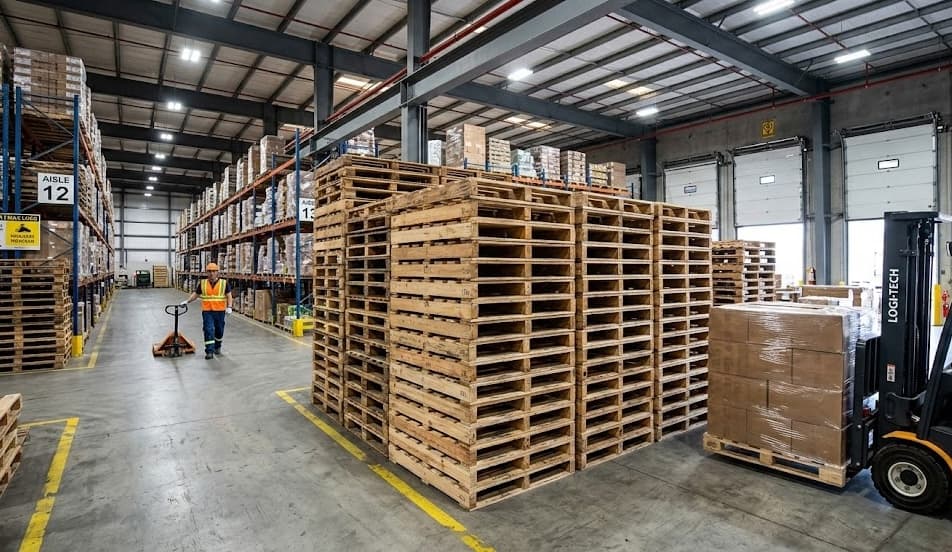
The two main pallet constructions serve different operational needs. Understanding the structural differences helps you choose the right design for your warehouse, shipping, and automation requirements.
Understanding the Two Designs
Every wood pallet falls into one of two structural categories: stringer pallets or block pallets. The difference is in how the top and bottom deck boards are connected and supported. Stringer pallets use two or three long boards (stringers) running lengthwise between the decks. Block pallets use a grid of nine wooden or pressed-wood blocks. This fundamental construction difference affects forklift access, load capacity, repairability, cost, and compatibility with automated systems.
Stringer Pallets: The North American Standard
Stringer pallets account for roughly 80% of pallets in North American circulation. They are cheaper to manufacture, lighter in weight, and easier to repair. Standard stringer pallets allow two-way forklift entry — forks can only enter from the two open ends. Notched stringer pallets have cutouts on the long sides that allow limited four-way access, though with some reduction in capacity. The standard GMA 48x40 is a stringer pallet.
Block Pallets: The Four-Way Option
Block pallets provide true four-way forklift entry. Forks can approach from any of the four sides without restriction or capacity reduction. This makes block pallets ideal for high-throughput operations where pallet orientation in racking or on the dock cannot always be controlled. Block pallets are also generally stronger — their nine-point support distributes weight more evenly than the three-point support of stringers.
Repairability Comparison
This is where stringer pallets have a clear advantage. Replacing a broken deck board on a stringer pallet takes about 90 seconds and requires basic tools. Block pallet repairs are more complex — damaged blocks require different extraction tools and replacement techniques. If your pallet program relies on repair to extend lifecycle, stringer pallets will be more cost-effective to maintain.
Automated System Compatibility
Modern automated storage and retrieval systems (AS/RS) increasingly require block pallets. The consistent footprint, uniform bottom deck, and four-way entry are critical for conveyor systems, automated guided vehicles (AGVs), and robotic palletizers. If you are building or upgrading an automated warehouse, check your equipment specifications carefully — many systems explicitly require block pallets.
Making the Decision
Choose stringer pallets when: cost per unit is a priority, your operation is primarily manual, you have a pallet repair program, and two-way forklift access is sufficient. Choose block pallets when: your operation requires four-way access, you use automated systems, weight distribution needs to be uniform, or your application benefits from the stronger nine-point support structure. If you are unsure, describe your operation to us and we will recommend the right design based on your actual needs, not just what we have in stock.
Need help with your pallet program?
We've been working with pallets for over 12 years. We'll give you honest, practical advice — not a sales pitch. Email us at info@sandiegopallet.com or use the contact form below.
Contact Us