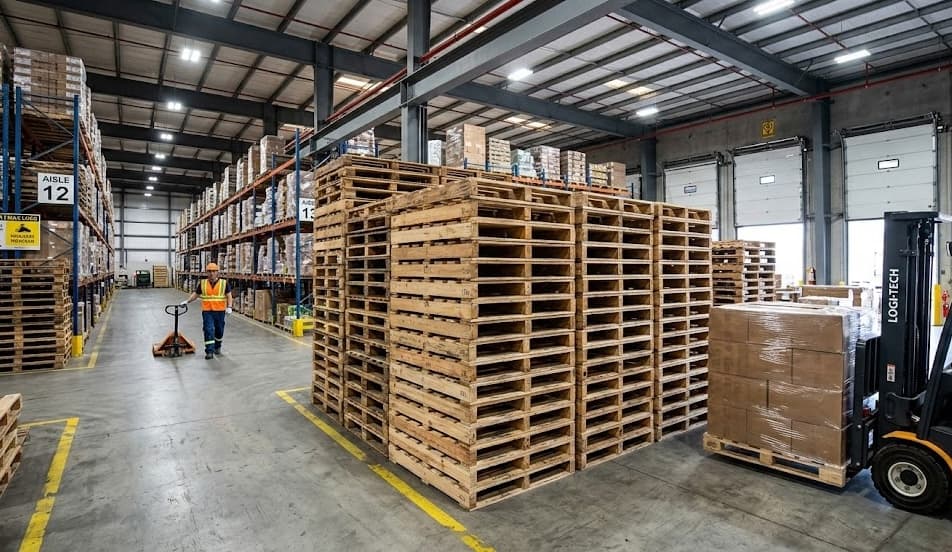
Automated storage and retrieval systems have strict pallet requirements. Using the wrong pallet in an automated facility can cause system jams, product damage, and expensive downtime.
Why Automation Changes Pallet Requirements
In a manual warehouse, a forklift operator can adjust for a slightly warped pallet, an extra inch of overhang, or a misaligned block. Automated systems cannot. Conveyors, AS/RS cranes, AGVs, and robotic palletizers operate on precise tolerances. A pallet that is 1/4 inch out of spec can jam a conveyor line. A missing bottom board can cause a sensor misread. The stakes are high: automated warehouse downtime costs between $5,000 and $50,000 per hour depending on the facility.
Dimensional Tolerances
Most automated systems specify dimensional tolerances of plus or minus 1/4 inch on length, width, and height. Some high-speed systems require plus or minus 1/8 inch. This is significantly tighter than manual operations, where an inch of variation is rarely noticeable. Pallet selection for automated facilities must prioritize dimensional consistency above all other factors.
Bottom Deck Requirements
Many automated systems use roller conveyors that contact the bottom deck of the pallet. This creates requirements that manual operations do not have: full perimeter bottom boards (no gaps), uniform bottom board thickness, no protruding nail heads on the bottom surface, and no damaged or missing bottom boards. Block pallets with a full bottom deck are often preferred for this reason.
Block vs. Stringer for Automation
The majority of new automated warehouse installations specify block pallets. The consistent footprint, uniform bottom deck, and true four-way entry are better suited to conveyor systems and robotic handling. However, some legacy systems were designed around stringer pallets. Always check your specific equipment manufacturer's pallet specifications before purchasing — do not assume.
Can You Use Used Pallets in Automated Systems?
Yes, but with careful selection. Used pallets for automated facilities must be individually inspected against the system's tolerance specifications. Not every used pallet will qualify — dimensional consistency declines with use and repair cycles. We offer automated-facility-grade selection as a service: pallets are measured and inspected against your specific system's requirements, and only qualifying units are included in your order.
Planning for Automation Transition
If you are planning to automate your warehouse in the next 1-3 years, start aligning your pallet program now. Switching pallet types mid-stream is more disruptive and expensive than transitioning gradually. Begin specifying automation-compatible pallets for new purchases, phase out non-compatible pallets through normal attrition, and work with your pallet supplier and automation integrator together to ensure alignment. Early planning prevents the scramble of needing thousands of spec-compliant pallets on day one of going live.
Need help with your pallet program?
We've been working with pallets for over 12 years. We'll give you honest, practical advice — not a sales pitch. Email us at info@sandiegopallet.com or use the contact form below.
Contact Us