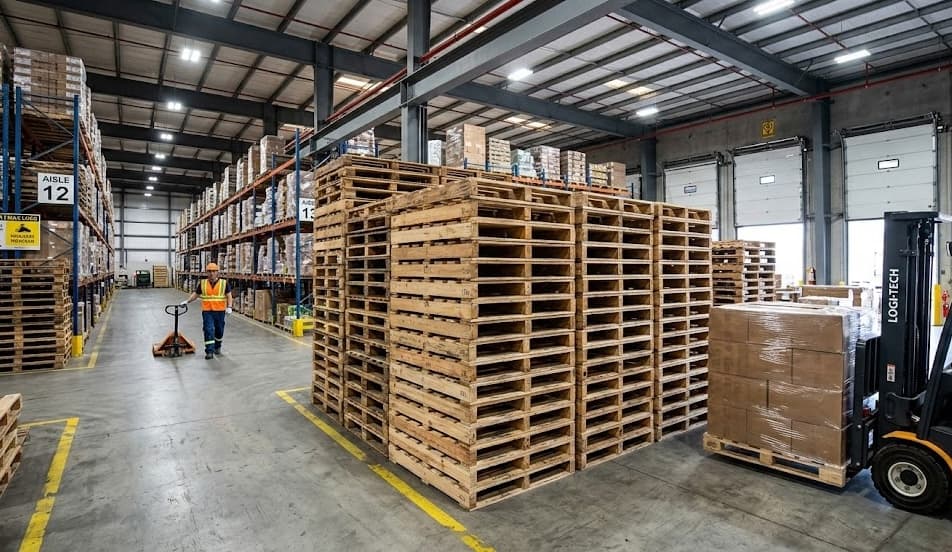
ESG reporting is no longer optional for mid-size and large companies. Your pallet program can be one of the easiest wins in your environmental data — here is how to measure it and report it properly.
Why Pallets Matter for ESG
Environmental, Social, and Governance reporting has shifted from voluntary best practice to business necessity. Customers, investors, and regulators increasingly require documented sustainability commitments. Pallets are one of the most overlooked data points in this conversation. A medium-size distribution center moves 30,000 to 80,000 pallets per year. Manufacturing a new GMA pallet releases approximately 22 pounds of CO2. If you can source even half of those pallets used instead of new, you are talking about hundreds of thousands of pounds of avoided emissions annually.
Calculating Your Carbon Avoidance
The formula is straightforward. Take the number of used pallets purchased per year and multiply by the carbon cost of manufacturing a new equivalent (roughly 22 lbs CO2 per GMA pallet). Then add the carbon avoidance from pallets you send to recycling instead of landfill — about 15 lbs CO2 per pallet diverted. For a company moving 50,000 pallets annually at a 60% used ratio, the total CO2 avoidance is approximately 935,000 pounds per year, equivalent to taking about 85 cars off the road.
Documentation We Provide
Our recycling and supply program provides several audit-ready documents: monthly volume and weight reports showing pallets diverted from landfill, CO2 avoidance calculations using industry-standard conversion factors, material recovery details showing where recycled material goes (biomass energy, mulch, steel recycling), and annual summary reports formatted for common ESG frameworks including GRI, SASB, and CDP. These documents are ready for your sustainability team to plug directly into reporting templates.
The Waste Hierarchy Applied to Pallets
The EPA waste hierarchy prioritizes reduction, then reuse, then recycling, then recovery, and finally disposal. A good pallet program hits the top three tiers simultaneously. You reduce by right-sizing orders and eliminating over-purchasing. You reuse by buying used pallets and selling back end-of-life pallets for refurbishment. You recycle by sending damaged-beyond-repair pallets to a recycler who chips the wood for biomass or mulch and recovers the metal fasteners for steel recycling.
Integrating Pallets into Your Sustainability Report
When writing about your pallet program in ESG reports, focus on three metrics: total pallets diverted from landfill (by weight and count), CO2 equivalent avoided through reuse and recycling, and percentage of pallets sourced from recycled or reused stock. These three numbers tell a clear, quantifiable story. Avoid vague language like 'we are committed to sustainable practices.' Instead, write 'In 2024, we diverted 42,000 pallets (680 tons) from landfill, avoiding an estimated 462 metric tons of CO2 equivalent emissions.' That is the kind of specificity that sustainability auditors and investors want to see.
Next Steps for Your Organization
Start by requesting a waste audit of your current pallet flow. How many pallets come in per month? How many go out? What happens to damaged pallets? Most companies do not track this data, which means they are missing an easy ESG win. We can help you set up tracking, switch to a used pallet supply model, and establish a recycling pipeline — all with documentation ready for your next sustainability report.
Need help with your pallet program?
We've been working with pallets for over 12 years. We'll give you honest, practical advice — not a sales pitch. Email us at info@sandiegopallet.com or use the contact form below.
Contact Us