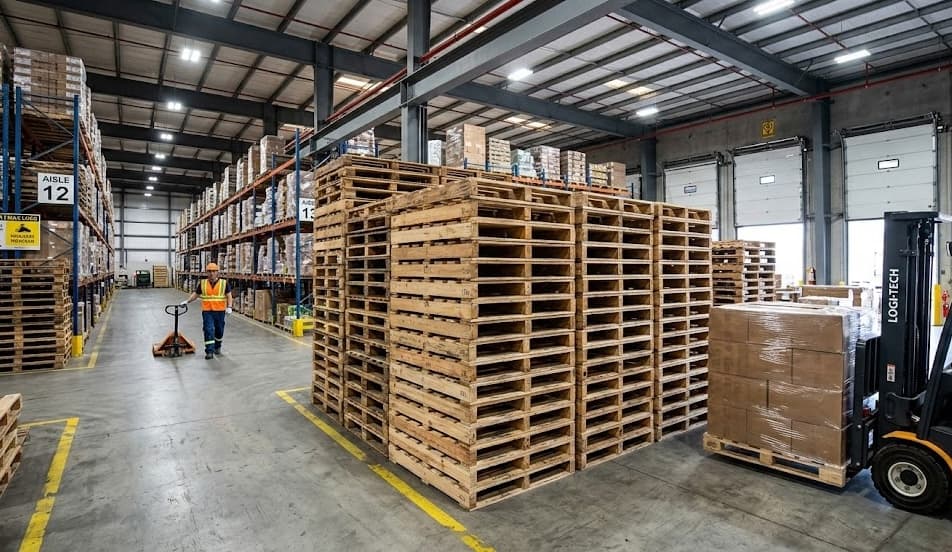
Every new pallet has an environmental price tag — from the tree that was harvested to the energy used in manufacturing. Here is a data-driven comparison of the environmental impact of new versus used pallets.
The Carbon Footprint of a New Pallet
Manufacturing a new standard GMA 48x40 pallet generates approximately 22 pounds of CO2 equivalent. This includes: timber harvesting and transport (6 lbs), sawmill processing (5 lbs), pallet assembly and fastening (3 lbs), and transportation to the end user (8 lbs). These figures come from lifecycle analysis studies conducted by the National Wooden Pallet and Container Association and Virginia Tech's Center for Packaging and Unit Load Design.
The Carbon Footprint of a Used Pallet
A used pallet's incremental carbon footprint is dramatically lower. The major environmental costs — harvesting, processing, and manufacturing — have already been incurred. The only additional carbon comes from: collection and transport to the refurbisher (3-4 lbs), inspection and any repair activities (0.5-1 lb), and transport to the buyer (4-5 lbs). Total incremental carbon: roughly 8-10 lbs CO2 equivalent — less than half that of a new pallet.
Water Usage Comparison
Lumber processing is water-intensive. Sawmills use water for log washing, blade cooling, and dust suppression. A single new pallet requires approximately 6.5 gallons of water in its production chain. Used pallets require virtually zero water for refurbishment — inspection, repair, and re-grading are dry processes. For a company using 10,000 pallets per year, switching to 70% used pallets saves roughly 45,500 gallons of water annually.
Timber Conservation
A standard new GMA pallet requires approximately 10-12 board feet of lumber. The United States produces roughly 500 million new pallets per year, consuming an estimated 5-6 billion board feet of lumber — about 40% of all hardwood lumber production in the country. Every used pallet that displaces a new pallet purchase directly reduces timber demand. At scale, the used pallet market is one of the most significant timber conservation mechanisms in industrial logistics.
End-of-Life: Landfill vs. Recycling
When a pallet reaches the end of its usable life, disposal method matters enormously. A pallet sent to landfill decomposes anaerobically, generating methane — a greenhouse gas 28 times more potent than CO2 over a 100-year horizon. A pallet sent to a recycler is converted to useful products: landscape mulch, biomass fuel, animal bedding, or composite material. The difference between landfill and recycling for a single pallet is approximately 15 lbs CO2 equivalent in avoided methane emissions.
Making the Switch Count
The environmental case for used pallets is clear and quantifiable. But the impact only materializes when organizations actually change their purchasing behavior. If your company is tracking environmental metrics or publishing sustainability reports, your pallet procurement is one of the lowest-effort, highest-impact changes available. We provide full environmental impact documentation with every order to help you quantify and report the difference.
Need help with your pallet program?
We've been working with pallets for over 12 years. We'll give you honest, practical advice — not a sales pitch. Email us at info@sandiegopallet.com or use the contact form below.
Contact Us