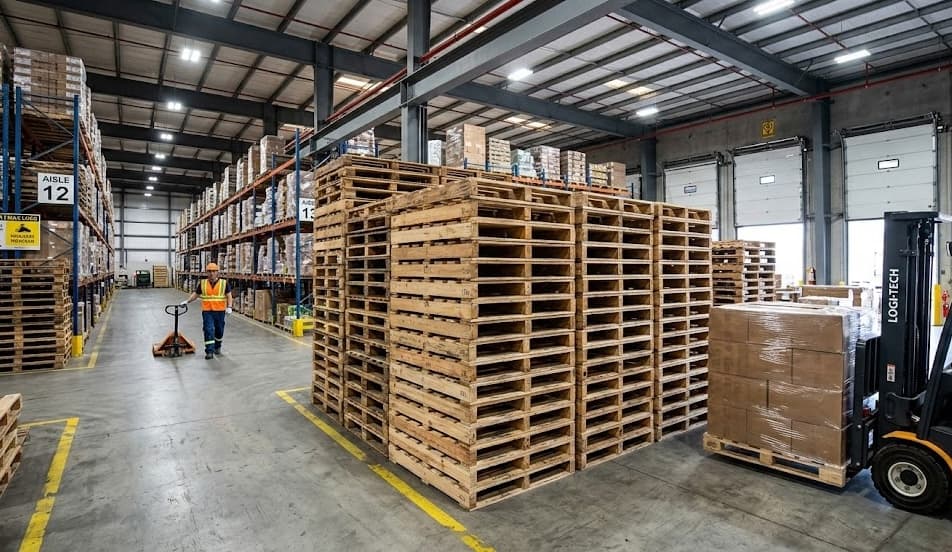
There's no universal standard for pallet grading. Here's how we grade, what industry standards say, and how to protect yourself when buying used pallets.
Why Grading Matters More Than You Think
Used pallets span a huge quality range — from near-factory-new to barely-functional. Without a grading system, you have no way to know what you're getting until the truck shows up at your dock. Grading systems exist to categorize that range into meaningful, consistent tiers that both buyer and seller understand.
The problem: there's no single national standard enforced by law. Different companies define grades differently, which means 'Grade A' from one supplier might be 'Grade B' from another. The National Wooden Pallet and Container Association (NWPCA) publishes guidelines, but they're voluntary. This lack of standardization is the single biggest source of disputes in the used pallet industry.
How We Define Our Grades
We developed our grading criteria based on the NWPCA guidelines, with practical modifications based on 12 years of operational experience and feedback from over 500 commercial clients. Our grading is performed by trained inspectors who evaluate each pallet against 12 specific criteria. Every pallet is inspected individually — we don't grade by batch or estimate.
Grade A — Premium Used
No broken, cracked, or missing deck boards on either the top or bottom deck. All stringers or blocks fully intact with no structural splits, compression damage, or missing components. No board replacements visible — if a board has been replaced, the repair must be indistinguishable from the original construction. Fork entry clearance measures 3.5 inches minimum on all designated entry points.
All fasteners must be flush with the deck surface — no protruding nails, screws, or staples that could damage product packaging or create safety hazards. Maximum 3 cosmetic marks (scuffs, minor stains, light discoloration) on the entire pallet surface. Dimensional tolerance within ±¼ inch of stated size. Moisture content below 19% (below 12% for heat-treated inventory). No contamination of any kind — no chemical stains, oil residue, mold growth, pest evidence, or odor.
Grade A pallets represent the top 15–20% of used pallets we receive. They typically come from single-use applications — a pallet that made one trip from manufacturer to distribution center and was returned in excellent condition. These pallets are functionally equivalent to new and are suitable for any application, including automated warehouse systems that require tight dimensional tolerances.
Grade B — Standard Used
Up to 2 deck boards replaced with matching-thickness lumber (species match not required). Minor stringer notch repairs permitted — companion board reinforcement is acceptable. Light surface weathering, discoloration, and shipping marks are considered normal. Up to 2 lead board edge chips not exceeding 2 inches in length. Fork entry openings may show minor wear marks but must maintain 3.25-inch minimum clearance.
All boards must be securely fastened — re-nailing with ring-shank nails is standard practice. Dimensional tolerance within ±⅜ inch of stated size. Moisture content below 22% for standard use. Grade B represents the industry workhorse — approximately 50–60% of used pallets fall into this category. These are pallets that have seen real service but remain structurally sound for normal warehouse loads.
Grade B is the most commonly purchased grade in the pallet industry. It offers the best cost-to-performance ratio for general warehousing, domestic shipping, and floor-stacking applications. Most businesses that don't have specific regulatory requirements (food-grade, pharmaceutical, etc.) will find Grade B meets their needs at 40–60% below new pallet pricing.
Grade C — Economy Used
Up to 4 deck boards replaced — mixed lumber species and minor thickness variation are acceptable. Multiple stringer repairs including companion boards and reinforcement plates. Heavy weathering, significant discoloration, and multiple shipping marks. Lead board edge damage up to 4 inches permitted if structurally stable. Visible board gaps up to 3.5 inches between deck boards. Fork entry may show significant wear — minimum 3-inch clearance required.
Dimensional tolerance within ±½ inch of stated size. Pallets may show twist or bow up to ¾ inch. Grade C pallets are the economy option — suitable for one-way outbound shipments, construction site staging, temporary storage, and any application where the pallet doesn't need to come back. At $1–$3 per unit, they deliver unbeatable per-trip economics.
How to Protect Yourself When Buying Used Pallets
Request written grading criteria from any supplier before purchasing. A reputable supplier will provide this without hesitation — it should be a standard part of their sales process. If they can't define what their grades mean in writing, that's a serious red flag.
Ask if you can inspect a sample load before committing to a large order. Any quality-focused supplier will agree to this — we offer sample pallets (2–3 units per grade) shipped at no charge for first-time orders over 100 units. Inspect delivery loads upon arrival and document any discrepancies immediately. Our guarantee: any pallet that doesn't meet its stated grade is replaced at no cost within 7 days of delivery. We maintain less than a 0.5% claim rate across all grades.
The Bottom Line
Pallet grading is not standardized across the industry, which means the burden falls on you — the buyer — to verify that your supplier's grades match your expectations. Ask for criteria, request samples, and establish a clear returns policy before placing large orders. With the right supplier, used pallets deliver exceptional value. With the wrong one, they deliver headaches.
Written by
San Diego Pallet Co. Editorial Team
November 8, 2024
Have questions about this topic?
We've been working with pallets for 12 years. We'll give you honest, practical advice — not a sales pitch.
Contact Us