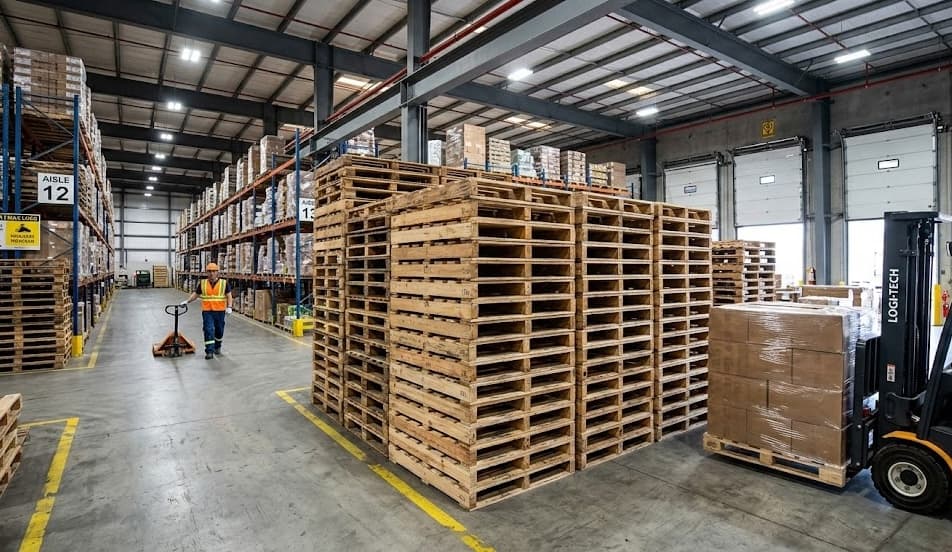
The two pallet designs cover 80% of North American warehouses. We break down construction, entry, repair, and cost so you can make the right choice.
The Two Dominant Designs
Walk into any North American warehouse and you'll find two types of pallets doing almost all the work: stringer pallets (GMA-style) and block pallets. Both carry goods. Both support forklifts. But they're built very differently, and that difference matters for your operation. Understanding these differences can save you thousands of dollars annually and prevent costly warehouse inefficiencies.
Stringer (GMA) Pallets — The American Standard
Stringer pallets use 3 boards running lengthwise — called stringers — to support the deck. They're the most common pallet in North America, accounting for roughly 70% of all pallets in circulation. Their popularity stems from two factors: they're cheaper to build (less raw material, simpler construction) and much easier to repair. A broken deck board can be replaced in under 2 minutes with a pry bar and a nail gun.
The standard GMA pallet measures 48 inches by 40 inches and weighs between 35–45 lbs depending on wood species and moisture content. The Grocery Manufacturers Association (GMA) established this size as the industry standard decades ago, and it remains the dominant footprint in grocery, retail, and general warehousing.
The trade-off with stringer pallets is fork entry. Standard stringers only allow 2-way entry — forklifts can approach from the two short ends. Notching the stringers (cutting a channel into the wood) provides partial 4-way entry, but with reduced load capacity at those entry points. Notched stringers typically lose 15–20% of their rated capacity compared to full stringers. For most floor-stacking operations, 2-way entry is sufficient. But for high-throughput warehouses where forklifts approach from multiple directions, this limitation becomes a bottleneck.
Block Pallets — The European Influence
Block pallets use 9 wooden or pressed-wood blocks arranged in a 3×3 grid between the top and bottom decks. This construction provides true 4-way forklift entry — any side, any angle. Block pallets are the standard in Europe (EPAL/EUR pallets are block-style) and are gaining popularity in North American operations that prioritize throughput speed.
Block pallets tend to be heavier (50–70 lbs) and more expensive to manufacture. New block pallets cost $20–$35 compared to $12–$18 for stringer pallets. However, their superior accessibility and typically higher load ratings (up to 4,800 lbs dynamic vs. 2,500 lbs for standard GMA) make them the preferred choice for heavy-duty applications.
The durability advantage of block pallets comes from their construction: the blocks distribute weight more evenly across the pallet footprint, reducing stress concentration at any single point. This means fewer deck board failures under heavy loads and better performance in racking applications where the pallet is supported only at the edges.
Repairability — Where Stringer Pallets Win
This is where stringer pallets win convincingly. A single broken board on a GMA pallet takes under 2 minutes to replace. The repair requires only a pry bar, a nail gun, and replacement lumber — all inexpensive and widely available. Block pallet repairs are more complex. Broken or loose blocks require different tools (often a block press or specialized jig), and the repair takes 3–5 times longer. Replacement blocks must match the original dimensions precisely, and sourcing them can be challenging for non-standard block sizes.
This repair cost difference compounds over the pallet's lifecycle. A GMA pallet might cost $1.50 per repair cycle; a block pallet might cost $4–$6. Over 5 repair cycles, that's $7.50 vs $20–$30 — a significant difference when multiplied by thousands of pallets.
Cost Comparison Summary
New GMA stringer pallet: $12–$18. New block pallet: $20–$35. Used Grade A GMA: $6–$10. Used Grade A block: $10–$16. Repair cost per cycle (GMA): $1–$2. Repair cost per cycle (block): $4–$6. Average lifespan (GMA): 3–5 years. Average lifespan (block): 5–8 years. When you factor in the longer lifespan of block pallets, the total cost of ownership difference narrows. But for operations that prioritize low upfront cost and easy maintenance, GMA stringers remain the more economical choice.
Our Recommendation
Choose GMA/stringer pallets for: general merchandise and grocery operations, single-direction material flow, cost-sensitive applications, operations with in-house repair capability, and domestic shipping where pallet recovery is planned. Choose block pallets for: high-throughput operations with multi-direction forklift access, pharmaceutical and food applications requiring all-sided access, automated storage and retrieval systems (AS/RS), heavy-duty manufacturing (loads over 3,000 lbs), and international shipping to European markets.
Not sure which type fits your operation? We stock both stringer and block pallets in multiple grades. Contact us with your application details and we'll provide a side-by-side comparison with real pricing for your specific volume.
Written by
San Diego Pallet Co. Editorial Team
January 15, 2025
Have questions about this topic?
We've been working with pallets for 12 years. We'll give you honest, practical advice — not a sales pitch.
Contact Us