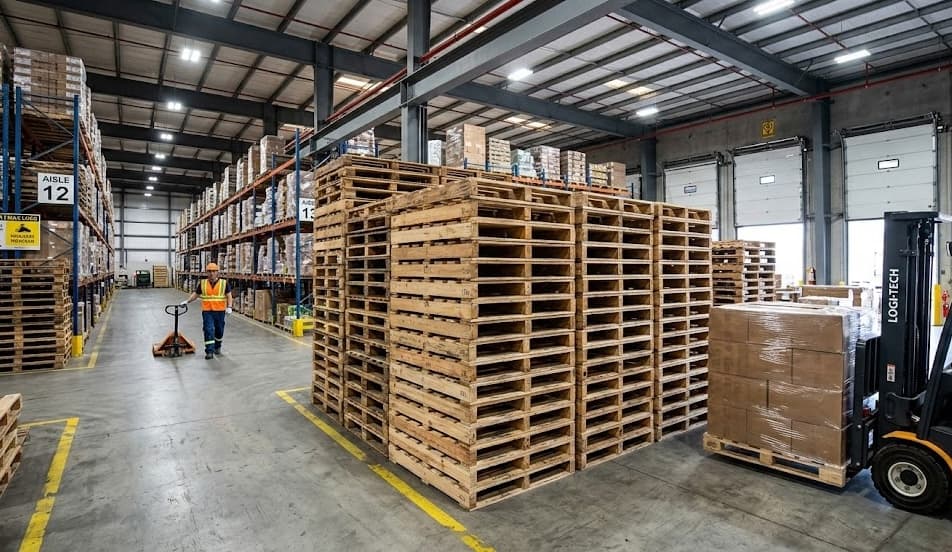
Sustainability reports increasingly ask about waste diversion. Your pallet program can be a meaningful data point — here's how to leverage it.
ESG and the Humble Pallet
Environmental, Social, and Governance (ESG) reporting has moved from voluntary best practice to business necessity for mid-size and large companies. Suppliers, investors, and customers increasingly require documentation of sustainability commitments. Pallets — despite being a mundane logistics item — represent a surprisingly impactful ESG data point.
Consider this: a medium-size distribution center might move 50,000 pallets per year. Manufacturing a new pallet releases approximately 22 lbs of CO₂ and consumes 22–30 lbs of fresh lumber. If half those pallets are sourced used rather than new, that's 550,000 lbs of CO₂ equivalent avoided annually — equivalent to taking about 50 cars off the road for a year. That's a number worth putting in your sustainability report.
The Three Pillars of Pallet Sustainability
Reuse: The highest-value sustainability action is extending pallet life. Every time a used pallet replaces a new one, you avoid the full manufacturing carbon footprint. Grade A and B pallets can see 15–35 additional load cycles, each one deferring a new pallet purchase.
Repair: When a pallet sustains damage, repair is almost always the more sustainable option compared to replacement. Our repair process uses salvaged lumber from irreparable pallets wherever possible, creating a closed-loop material flow. A single board replacement consumes about 2 lbs of wood; manufacturing a replacement pallet from scratch consumes 50–60 lbs.
Reclamation: At end of life, pallets are dismantled into their component materials. Sound boards are stockpiled for future repairs. Nails and fasteners are collected for steel recycling. Irreparable wood is chipped for mulch, animal bedding, or biomass fuel. In our operation, zero pallet material goes to landfill — we achieve a documented 100% diversion rate.
What We Document for ESG Reporting
Our recycling program provides monthly reports covering: total weight and unit count of pallets diverted from landfill, CO₂ avoidance calculations using EPA-approved methodology, material recovery breakdown (repaired, reused, chipped, steel recycled), recycling rate certification (percentage of material recovered vs. total intake), and water and energy savings estimates based on new-pallet-avoidance calculations.
These reports are formatted to align with common ESG frameworks including GRI, CDP, SASB, and TCFD. If your organization uses a proprietary reporting format, we can adapt our data presentation to match. Several of our clients have incorporated our recycling data directly into their annual sustainability reports and SEC filings.
Getting Started
Setting up a pallet recycling program doesn't require a large minimum volume. We work with businesses recycling as few as 50 pallets per month up to operations generating 10,000+ monthly. The process starts with a simple audit: we visit your facility, assess your pallet flow (incoming, outgoing, damaged), and design a collection schedule that fits your operations without disrupting your warehouse workflow.
There's no cost for the initial audit, and for most clients, the buyback value of their used pallets offsets 60–100% of the recycling program cost. Some clients actually generate net revenue from what was previously a waste disposal expense. Contact us to schedule your free pallet audit.
Written by
San Diego Pallet Co. Editorial Team
September 18, 2024
Have questions about this topic?
We've been working with pallets for 12 years. We'll give you honest, practical advice — not a sales pitch.
Contact Us